
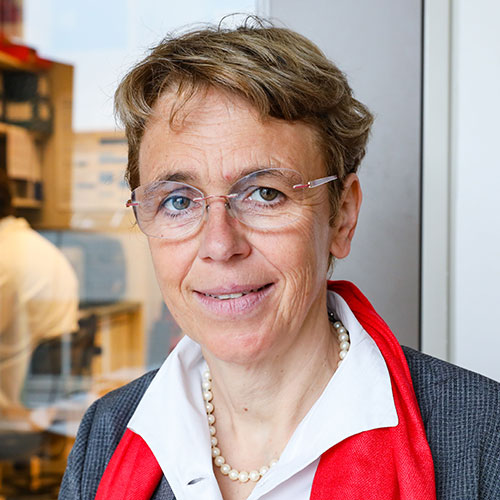
Titles and Affiliations
Associate Professor of Life Sciences
Professor of Breast Biology, Institute of Cancer Research London, UK
Research Area
Understanding how hormones influence breast cancer development in younger women.
Impact
The most common breast cancer subtype is estrogen receptor (ER)-positive, meaning the tumors depend on the hormone estrogen to grow and are typically well controlled by anti-hormone therapy. The incidence of this subtype is increasing among younger women and tends to be more aggressive and harder to treat than in older women, for reasons that are still poorly understood. Dr. Brisken’s research provides critical insights into how hormones and environmental exposures impact breast cancer risk and aims to further elucidate why breast cancer in younger women behaves differently than in postmenopausal women. By uncovering age-specific differences, the research could guide new strategies to prevent breast cancer and improve treatments tailored to younger patients.
Progress Thus Far
Using advanced laboratory models that closely mimic early onset breast cancer, Dr. Brisken and her team observed tumors grew more efficiently and spread more readily compared to models representing older-onset disease. Estrogen is known to act on cells in two ways: a slower, well-established pathway in which it enters the nucleus and directly controls gene activity, and a faster pathway in which it triggers signals from the cell surface that can rapidly switch on networks promoting cell growth and movement. The team’s early findings suggest that tumors in younger women may rely more heavily on this faster, cell-surface pathway than tumors in older women, a difference that could help explain why breast cancer in younger women often behaves more aggressively. To investigate this further, the team is using a form of estrogen called estetrol (E4), which activates the traditional, slower signaling route while blocking the faster one, allowing them to study the effects of each separately.
What’s Next
Dr. Brisken’s team will study the effect of E4 treatment, to determine whether blocking the faster signaling route can reduce tumor growth and spread. This work could reveal a previously unrecognized vulnerability in early-onset breast cancers and may ultimately lead to more effective, age-tailored hormone therapies, potentially changing how scientists and clinicians think about estrogen’s role in breast cancer.
Biography
Cathrin Brisken, MD, PhD is a physician-scientist who studies how reproductive hormones guide normal breast development—and how these same signals go awry in cancer. Early in her career, she showed that estrogen, progesterone, and prolactin act at sequential stages with the breast epithelium as the primary target, and that hormones work through local “paracrine” messengers that coordinate different cell types. Her team identified several of these messengers and uncovered a link—via the secreted enzyme ADAMTS18—between hormone signaling and the breast’s supporting matrix that fuels stem-cell activity.
Committed to relevance for patients, Dr. Brisken built models that preserve human biology. She created an ex vivo system using fresh human tissue to confirm that the progesterone–RANKL axis drives proliferation in the normal breast. In translational research, her group discovered why traditional mouse engraftment pushes human tumor cells toward a false EMT state and pioneered intraductal engraftment—keeping cells in their natural ductal niche. This raised ER+ patient-derived xenograft success from ~2.5% to >90% and yielded the first robust lobular carcinoma xenografts and provided entirely new experimental opportunities to study dormancy and metastasis.
Her leadership extends to cancer prevention and training: she provided evidence that prenatal exposure to BPA can durably alter breast development and that the androgenic properties of contraceptive progestins determine breast cancer risk. Dr. Brisken co-founded the International Cancer Prevention Institute; she led the EPFL doctoral school with 2000 students and coordinated a €4.2M EU doctoral network in Cancer Prevention across seven countries. As part-time faculty at London’s ICR, she leads efforts to design clinical trials for lobular carcinoma patients and to personalize endocrine therapy.