


Postpartum Breast Cancer
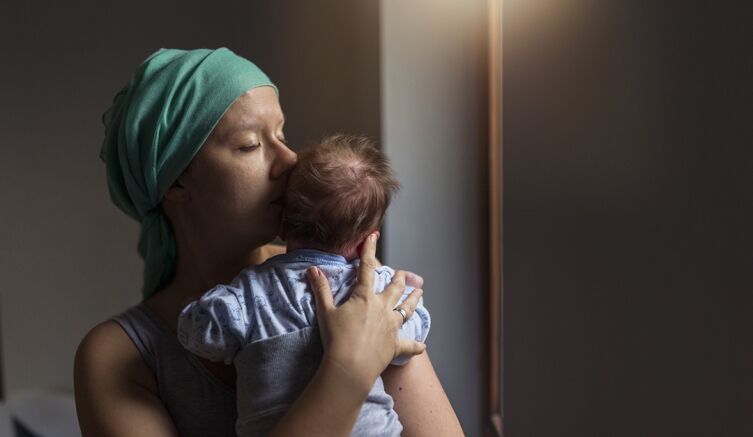
What to know about breast cancer in the months to years after giving birth.
Breast cancer can be diagnosed at any stage of a woman’s life, including in the months and years after giving birth. Postpartum breast cancer is not widely talked about, but it is more common in younger women diagnosed with the disease than many people realize, and it has features that set it apart from breast cancer diagnosed at other times of life.
Here, learn what postpartum breast cancer is, what warning signs to watch for, and find guidance on when to seek care.
Key takeaways
- Postpartum breast cancer is breast cancer diagnosed within approximately five to 10 years after childbirth.
- Researchers are finding the biological changes the breast undergoes after weaning can create conditions that allow a pre-existing cancer to grow and spread.
- Normal breast changes during and after pregnancy can make symptoms easier to miss. Persistent changes should always be evaluated by a clinician.
- Postpartum breast cancer is estimated to account for roughly 25 to 50% of all breast cancer diagnoses in women under 45.
- It tends to be diagnosed at a more advanced stage and carries a higher risk of spreading than breast cancer diagnosed in women who have not recently given birth.
Table of contents
- What is postpartum breast cancer?
- Why postpartum breast cancer can be harder to spot
- What are the symptoms of postpartum breast cancer?
- When does postpartum breast cancer happen?
- How is postpartum breast cancer diagnosed?
- How is postpartum breast cancer treated?
- How common is postpartum breast cancer?
- Pregnancy, breastfeeding, and postpartum breast cancer
- When should you call a doctor?
- Frequently Asked Questions
What is postpartum breast cancer?
Postpartum breast cancer is breast cancer diagnosed within approximately five to 10 years after childbirth. Research suggests the five-year window directly following childbirth as the period of highest elevated risk, with some studies suggesting risk may remain somewhat elevated for up to 10 years after childbirth.
Postpartum breast cancer is not directly caused by pregnancy. Instead, research suggests that the changes the breast goes through after a woman stops breastfeeding, a biological process known as involution, may allow abnormal cells that were already present to grow and spread. Involution is the normal, necessary process by which breast tissue remodels and shrinks after lactation ends. During this remodeling, a cascade of inflammatory changes occurs in the breast that resemble wound healing. Based on findings from current research, this environment may help cancer grow and spread.
This distinction matters because it means postpartum breast cancer is not a reason to avoid pregnancy. But it is a reason to stay attentive to breast health in the years after giving birth.
This page is for educational purposes only and is not a diagnostic tool. If you have concerns about your breast health, please speak with a clinician.

Why postpartum breast cancer can be harder to spot
The breast undergoes profound changes during and after pregnancy. During breastfeeding, breasts are often larger, firmer, and denser than usual. They may be tender, engorged, or asymmetrical. After weaning, the tissue softens and remodels, sometimes unevenly, for months.
This makes it difficult to notice a new or abnormal change. A lump that might be immediately apparent in a different context can easily be mistaken for a blocked duct or general breastfeeding tenderness. And because breast cancer in younger women is not what most people, or even many physicians, are looking for, there is an additional risk of delayed diagnosis. This is not a reason for alarm, but it is a reason to know your own body, to note changes that persist and to seek an evaluation from your doctor.
What are the symptoms of postpartum breast cancer?
The warning signs of postpartum breast cancer are similar to those of breast cancer at any age:
- A new lump or thickening in the breast or underarm that does not resolve
- Breast swelling, warmth, or redness that is not explained by infection, or that does not improve with treatment for mastitis (inflammation of the breast common in breastfeeding women, typically caused by trapped milk, blocked milk ducts, or bacteria)
- Skin changes, including dimpling, puckering, or a texture resembling an orange peel
- Nipple changes, including inversion, discharge that isn’t milk, or crusting that is new
- Persistent pain in one specific area of the breast that does not change with your menstrual cycle
Many of these symptoms can overlap with benign postpartum conditions such as mastitis, blocked milk ducts, or hormonal changes after weaning. If a change doesn’t resolve within one to two weeks, or if you have any doubt, have it evaluated.
When does postpartum breast cancer happen?
Again, postpartum breast cancer often occurs around five to 10 years after childbirth. Research suggests the five-year window directly following childbirth as the period of highest elevated risk, with some studies suggesting risk may remain somewhat elevated for up to 10 years after childbirth.
How is postpartum breast cancer diagnosed?
If you or your doctor notices a persistent breast change, the next steps typically begin with a clinical breast exam followed by imaging. For women who are actively breastfeeding, an ultrasound, which uses sound waves to create images of breast tissue, is often the first imaging tool used, since mammography can be more difficult to interpret in lactating breast tissue. After weaning, use of mammography is more standard.
If imaging identifies something suspicious, a biopsy, or the removal of a small amount of tissue for laboratory analysis, may be recommended to determine whether cancer is present.
Postpartum breast cancer is more likely to be diagnosed at an advanced stage than breast cancer in older women. This is because symptoms may be attributed to normal postpartum changes, the associated tumor biology is thought to be more aggressive, and routine screening mammography typically does not begin until age 40. If you have a strong family history of breast cancer, a known mutation in a gene linked to breast cancer risk such as BRCA1 or BRCA2, or other elevated risk factors, ask your doctor whether earlier or more intensive screening is right for you.
How is postpartum breast cancer treated?
Treatment for postpartum breast cancer follows the same general approach as breast cancer treatment at any age: The type, stage, and biological profile of the cancer guide the plan, which may include surgery, chemotherapy, radiation, targeted therapy, hormone therapy, or immunotherapy, often in combination.
For younger women, treatment decisions often take a longer view, considering the decades of life ahead and the potential long-term effects of treatment on fertility, cardiovascular health, and quality of life. For women who wish to preserve the option of future pregnancies, a fertility specialist can often be consulted early in the planning process. Your care team, which may include an oncologist, surgeon, and other specialists, will develop a plan tailored to your specific situation.
How common is postpartum breast cancer?
It is estimated that approximately 18,000 women in the United States are diagnosed with postpartum breast cancer each year, and it is thought to account for roughly 25 to 50% of all breast cancer diagnoses in women under 45.
Despite these numbers, it remains less well known than other forms of the disease—in part because it is defined by when it arises rather than by a specific tumor biology, which has made it harder to study and recognize. Awareness among both patients and clinicians is improving, but there is still work to be done.
Pregnancy, breastfeeding, and postpartum breast cancer
Pregnancy itself does not cause breast cancer, and breastfeeding does not increase breast cancer risk. In fact, longer duration of breastfeeding is associated with a reduced lifetime risk of breast cancer overall. Part of this protective effect comes from the hormonal changes that occur during lactation. Most women who breastfeed experience a delay in the return of their menstrual periods after childbirth, which reduces their lifetime exposure to estrogen, a hormone that can promote the growth of certain breast cancer cells. The body also naturally renews breast tissue during pregnancy and breastfeeding, replacing older cells with new ones, which may reduce the number of cells that could potentially become cancerous over time.
What does appear to create a window of elevated risk is the period after weaning, specifically the involution process described above. This is a subtle but important distinction. It is the remodeling that follows that warrants attention.
For women who are pregnant or breastfeeding and notice a change in their breasts, the right approach is the same: If a symptom persists or feels unusual, bring it to your clinician’s attention. Don’t assume that every change is simply part of breastfeeding. Your care team can evaluate you appropriately at any stage.
When should you call a doctor?
Contact your clinician if any of the symptoms described above persist for more than one to two weeks without a clear explanation. If something feels different and it isn’t going away, getting evaluated is never the wrong call. When seeking evaluation, always let your clinician know if you have recently given birth or stopped breastfeeding, and when—this context is important for how they interpret what they find.
Frequently Asked Questions
Prognosis depends on the stage at diagnosis, the tumor subtype, and how quickly treatment begins, the same factors that shape outcomes across all breast cancers. Research consistently shows, however, that women diagnosed with breast cancer in the postpartum period have poorer overall survival than women of the same age who have not recently given birth, independent of stage and tumor type.
While triple-negative breast cancer (TNBC), an aggressive subtype that lacks hormone receptors, is more common in postpartum patients than in older women, the poor prognosis of postpartum breast cancer is seen across all subtypes, including estrogen receptor (ER)-positive disease. ER-positive tumors diagnosed in the postpartum period tend to behave more aggressively than the same tumor type diagnosed in women who have not recently given birth — a finding that points to the biology of involution as a driver of risk, independent of the cancer’s molecular profile.
What research has also established is that postpartum breast cancer carries a significantly higher risk of spreading to distant sites (metastasis) than breast cancer in women who have not recently given birth. When it does spread, it tends to travel to the liver, a site of metastasis associated with poorer outcomes.
This makes early detection especially important. The sooner postpartum breast cancer is caught and treated, the better the likely outcome. Researchers are actively working to understand the biology behind this higher risk of metastasis, and to find ways to intercept it.
Yes. Many people do live long, full lives after a breast cancer diagnosis, especially when the cancer is caught early and treated promptly. Advances in surgery, systemic therapy, and targeted treatments have improved outcomes across breast cancer subtypes over the past two decades. For younger women, survivorship over many decades is increasingly the norm and a growing focus of research and clinical care.
The most common warning signs are a new or persistent lump in the breast or underarm, breast swelling or redness that doesn’t resolve, skin changes such as dimpling or an orange-peel texture, nipple changes or discharge, and localized breast pain that doesn’t fluctuate with your menstrual cycle. Because these can overlap with benign postpartum conditions like mastitis (inflammation of the breast) or blocked ducts, persistence is key to watch for. Anything that doesn’t resolve within one to two weeks should be evaluated by a clinician.
Selected References 
- “Can Breastfeeding Really Lower Your Breast Cancer Risk?” UT MD Anderson Cancer Center
- “Postpartum Breast Cancer: A Rare Breakthrough for a Hidden Threat.” CU Anschutz Innovations
- “Study Confirms the Unique Danger of Postpartum Breast Cancers.” OHSU News
- “Patterns and Prognostic Implications of Distant Metastasis in Breast Cancer Based on SEER Population Data.” Scientific Reports, vol. 15,
- “The Prognosis of Women Diagnosed With Breast Cancer Before, During and After Pregnancy: A Meta-Analysis.” Breast Cancer Research and Treatment, vol. 160
- “Pregnancy and Breast Cancer: When They Collide.” Journal of Mammary Gland Biology and Neoplasia, vol. 14
- “The Rodent Liver Undergoes Weaning-Induced Involution and Supports Breast Cancer Metastasis.” Cancer Discovery, vol. 7, no. 2
- “Breast Cancer and Breastfeeding: Collaborative Reanalysis of Individual Data From 47 Epidemiological Studies in 30 Countries, Including 50,302 Women With Breast Cancer and 96,973 Women Without the Disease.” The Lancet, vol. 360, no. 9328
- “Postpartum Breast Cancer Has a Distinct Molecular Profile That Predicts Poor Outcomes.” Nature Communications, vol. 12
- “High Incidence of Triple-Negative Breast Cancers Following Pregnancy and an Associated Gene Expression Signature.” SpringerPlus, vol. 4


