

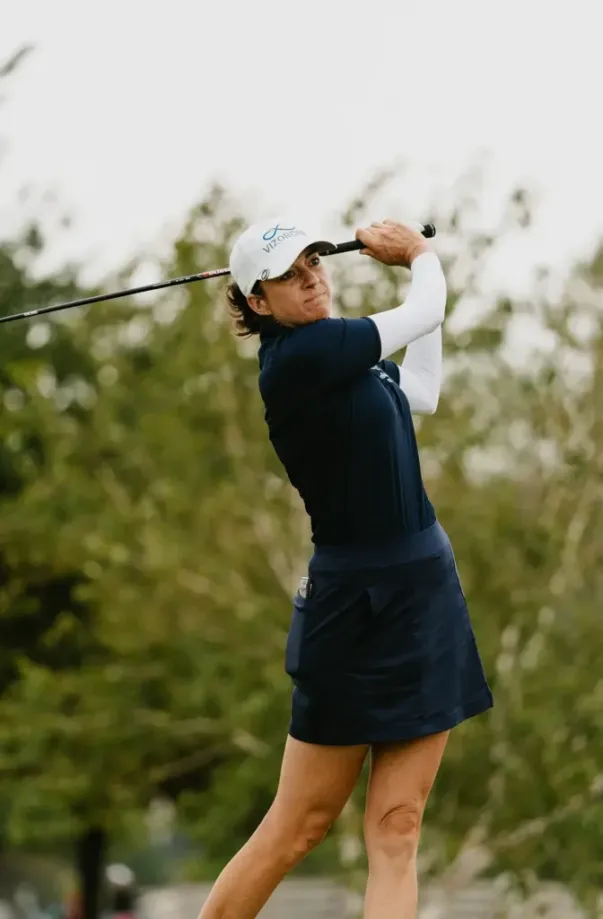
The LPGA Tour player talks treatment, community, and the importance of research
As a professional golfer and Ladies Professional Golf Association (LPGA) tour player, Kim Kaufman often focused on staying in tune with her body. She noticed a dimple in her left breast in the spring of 2024, which, coupled with a doctor noting she had “fatty” breast tissue, left her making a note to bring up the change with her provider at her next office visit, in September. When the appointment time arrived, she was “looking forward” to being told all was fine.
Unfortunately, that’s not what happened. Her doctor sent her for a mammogram, which ultimately led to the need for more testing. However, her insurance would not cover the doctor-ordered PET scan, which checks whether cancer has spread. “So, I paid for my own CT scan,” she recalls of how she ended up having another imaging test.
Kim received a diagnosis of stage 2B invasive ductal carcinoma (IDC). Invasive ductal carcinoma originates in the cells lining the milk ducts of the breast, and accounts for approximately 75% of invasive breast cancers.
“It’s so scary to hear [the word ‘cancer’],” she says, reflecting on her diagnosis. “We can be so afraid of it, but once I got in to see those doctors I felt better.” In fact, Kim says she had a cancer mentor of sorts, who said: “It’s not one day at a time; it’s one hour at a time.”
Though she ended up taking the year off from professional golf to focus on treatment, she continued to practice at home. “I looked normal, I felt normal,” she recalls. But, in the background, she’d just had a lumpectomy to remove the tumor, and was waiting for her oncotype score to determine the risk of her cancer returning (known as recurrence). After the surgery, the physical signs of undergoing treatment began to take hold. “It all became really real when I went to chemotherapy,” she remembers.
As a professional golfer, taking time away from competition turned out to be its own challenge. “It was hard sitting on the couch. It was hard.” But she got through it. “You have a lot of better days [than] I think people think,” she says.
After chemotherapy, she began radiation therapy and started exercising again. “When radiation started, I went to the gym. I did okay with radiation therapy until the very end,” she remembers. She believes her age was a factor: “I always say [that] being young, half the age of most people in that room, I think [helped] my body handle it.”

As she went through her diagnosis and treatment, Kim found community and hope in women she already knew. “When you get [breast cancer], you find out people in your close circle had it,” she says. She learned that several women in her life had undergone breast cancer treatment decades earlier. “The first thing they said was: ‘Kim, your treatment is going to be so much better.’”
She completed treatment in June, but, as is the case for many former cancer patients, has regular follow-up appointments. Every three months, she gets a circulating tumor DNA (ctDNA) blood test called Signaterra to help detect recurrence.
When asked what a cure means to her, Kim says: “A cure is when you walk into a doctor’s office and they say, ‘we are going to put you in remission.’ I would think of that as a cure.”
She wants others in her position to know that they’re strong enough to face breast cancer head-on. “I often say you’re more afraid of [breast cancer] when you don’t have it than when you do have it,” she says. “Ignoring it is not the answer.”
Kim is confident that advances in research will allow treatment options to continue to evolve and advance. “Research is where everything is going to happen,” she says.


