

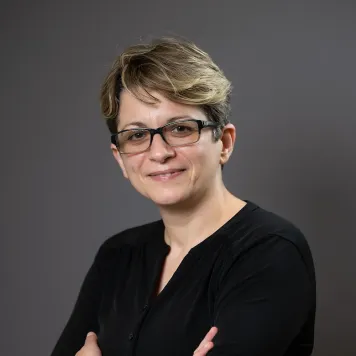
Titles and Affiliations
Professor & Vice-Chair of AI and Data Science Research
Department of Radiology
Research Area
Developing an AI model that combines 3D breast imaging with genetic and clinical data to deliver more accurate, personalized breast cancer risk predictions.
Impact
Roughly 40 million American women get a mammogram every year and are part of breast cancer risk assessment. Current breast cancer risk assessment tools, however, are so complex that most providers do not use them in practice, meaning most women never receive a truly personalized risk score at all. Digital breast tomosynthesis (DBT), a 3D X-ray imaging technology, is rapidly replacing conventional 2D mammography due to its superior tissue visualization and higher cancer detection rates, yet most AI risk tools today still rely on flat 2D images, missing the opportunity to combine richer 3D imaging with a woman’s clinical and genetic information. Dr. Kontos and her team at Columbia University were among the first to develop AI methods for analyzing 3D DBT images to predict breast cancer risk, and their research has shown that these 3D imaging measures outperform standard 2D mammography in predicting risk.
What’s Next
Dr. Kontos is developing a novel AI model called Attention-based Slices-to-view Hierarchical Aggregation (ASHA), built specifically for 3D DBT imaging that integrates it with clinical risk factors and genetic data, including BRCA1/2 status and polygenic risk scores, to generate a more accurate, individualized risk picture for each woman. The model uses a new AI approach that focuses on clinically relevant regions within the scan, making it both powerful and interpretable to clinicians who will use it. To build and test ASHA, Dr. Kontos will develop a research database linking DBT images with clinical and genetic data for over 12,000 diverse women at Columbia University Irving Medical Center, a cohort that includes 27% Hispanic and 11% Black women, addressing a critical gap in most AI risk tools today. All resulting tools will be made freely available, building on the team’s prior open-source software already used by researchers worldwide, with the ultimate goal of a larger multi-institutional study across Columbia, the University of Pennsylvania, and the national ECOG-ACRIN TMIST trial.
Biography
Despina Kontos, PhD is the Herbert and Florence Irving Professor of Radiological Sciences (in Radiology and the Herbert Irving Comprehensive Cancer Center), Vice-Chair of AI, Data Science, and Engineering Research, and founding Director, Center for Innovation in Imaging Biomarkers and Integrated Diagnostics (CIMBID) at the Columbia University Irving Medical Center (CUIMC). She is also the inaugural Chief Research Information (CRIO) officer for CUIMC. Dr. Kontos received her C.Eng. Diploma in Computer Engineering and Informatics from the University of Patras in Greece and her MSc and Ph.D. degrees in Computer Science from Temple University in Philadelphia. She completed her postdoctoral training in radiologic physics and biostatistics at the University of Pennsylvania, and additional postgraduate training in Cancer Molecular Biology and Therapeutics from Harvard Medical School. Dr. Kontos’ research interests lie at the interface of engineering, data science, and medical imaging applications. Most of her research to date has focused on leveraging machine learning and AI to investigate imaging as a predictive biomarker for guiding precision cancer screening, prognosis, and treatment, while integrating with other emerging multi-omic biomarkers, such as molecular profiling, liquid biopsy, and family history and demographic data from the electronic health record (EHR). Specifically in the field of breast cancer research, she has developed pioneering approaches using artificial intelligence (AI) to quantify breast density and estimate breast cancer risk from digital breast tomosynthesis (DBT) scans, aiming to provide more informed clinical decision-making for personalized screening and tailored risk-reduction interventions for women. She has published more than 100 papers in this field, leading several research studies funded by the NIH/NCI and private foundations.

