

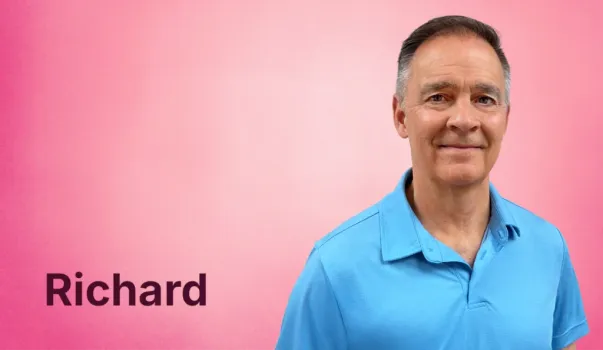
Richard took part in a clinical trial to further research into male breast cancer
When Richard Loud learned he had breast cancer at age 59, he immediately sprang into action. That’s no surprise, considering he’s an experienced runner who has completed more than 50 marathons.
“I didn’t break down crying on the side of the road or anything,” says the now 61-year-old father of two from Ballston Spa, NY. “I just was like, Okay, now what’s next?”
That can-do attitude served Richard well during his career as an engineer for GE Vernova, but breast cancer was uncharted territory. Still, he was determined to make meaning out of his experience, which started when he felt a lentil-sized lump under his right nipple in 2024. Although he knew men could get breast cancer, that wasn’t where his mind initially went.
“I thought it was just a cyst,” he recalls. He also noticed his nipple had flattened, though he didn’t think much of it. But when he woke up a few months later with an ache—and a new lump—in his armpit, he called his doctor, who sent him for a mammogram and ultrasound.
The mammogram came back suspicious, prompting a biopsy. At this point, it was the holidays, and Richard didn’t expect to hear back right away, something he says helped him prepare emotionally for the diagnosis, which he received two days after Christmas.
A few days into the new year, Richard met with a local surgeon who explained his diagnosis: invasive ductal carcinoma. Doctors needed to run more tests to determine the cancer’s stage. Thankfully, an MRI, CT scan, and bone scan showed that the cancer was isolated to his right breast. That put him at stage 2 breast cancer, which thanks to research, can be successfully treated.
“That day started off as one of the worst days, and ended up as one of the best days,” he recalls. “Everything was bad news up to that point. That day, I got the best news: You have cancer, but it’s not as bad as it could have been, and it’s treatable.”
Richard learned that he would most likely need chemotherapy, surgery, radiation, and hormone therapy to treat the cancer. He set up an appointment with a local oncologist, and also sought a second opinion three hours from his home at Dana-Farber Cancer Institute in Boston.
“In my mind, something like this, you don’t just take one opinion,” Richard says. “You take your car to another mechanic.”
So Richard made an appointment with a surgeon and oncologist at Dana-Farber, and also made chemotherapy and nurse follow-up appointments locally. He told the local oncologist to plan on seeing him if Dana-Farber recommends the same treatment approach.
But then, a phone call from Dana-Farber changed everything.
“They said, the director of the program for breast cancer in men read your case, and he really wants to see you. Is it okay if we change your appointment to him?” Richard recalls. The surgeon, too, said she would “come in early or stay late that day to meet with you.” Richard sensed something was brewing.
Sure enough, when Richard met Dr. Jose Pablo Leone, director of the Program for Breast Cancer in Men at Dana-Farber, he told Richard that he was a candidate for a clinical trial for men with breast cancer. This meant that Richard would skip chemotherapy and instead do endocrine (hormone) therapy, a far less invasive treatment plan.
With men only making up 1% of all breast cancer cases, research often focuses on women. Dr. Leone’s trial—called ETHAN—is trying to understand how well male breast cancer responds to endocrine therapy and which endocrine therapy regimen is the most effective treatment for the cohort.
“It makes sense that almost all of the research money goes to research for women, but the men are still out here,” he says. “We might be 1%, but when you’re that 1%, that’s 100% of your reality.”
Richard was eager to join the trial: Not just for him, but for every man who came after him, to help push research forward.
“Once I made that decision to do it, it turned this nightmare really into an adventure, because I became the research,” he says. “I got to watch the whole thing unfold.”
He also found fitness inspiration: Richard was excited to learn that the ETHAN trial was being funded by the Breast Cancer Research Foundation (BCRF). He knew that BCRF had a charity team for the New York City Marathon, and was eager to join other runners supporting BCRF.
“BCRF is the only organization that had the guts to fund the trial that I was on, to fund the research that I participated in,” he says. “And research is what gets us closer to curing cancer.”
Richard started the ETHAN trial in early February 2025, which first entailed taking an aromatase inhibitor to lower estrogen, followed by a gonadal suppressor to decrease testosterone and a CDK4/6 inhibitor to block the cancer’s growth. Treatment lasted about four months, and then he had surgery in the days following so doctors could measure his levels of Ki-67 protein, a marker that signals how aggressive the cancer is. Incredibly, over the course of active treatment, Richard ran four marathons.
When it came time to run the New York City marathon in November, Richard literally took to the streets to tell spectators about male breast cancer and BCRF’s work.
“I would stop along the way where there were crowds of people and tell them why I was running for BCRF, and I’m pointing at the guys like, you can get [breast cancer]. It’s not just the women—you all can get it.”
When he ran the Boston Marathon the following spring, Richard recorded his testimonial multiple times along the marathon route. He’s since spread awareness on social media, with his videos blending the reality of his experience with moments of humor to uplift others.
“I made a pact with myself, and maybe the universe: Get me through this, and I’ll make sure everybody knows,” he says. “I’ll do something with it.”
Today, Richard is training for his next marathon (he’ll represent Team BCRF at the New York City Marathon again in 2026) and living life to the fullest. He is eternally grateful to play a role in research and hopes that the number of women—and by extension, men—with breast cancer decreases over time. He also hopes more people will be able to benefit from the same targeted therapies he was on, and that his story helps raise awareness of male breast cancer. He cites a Lewis Capaldi song, “Survive,” as his personal anthem that got him through the darkest days.
“Your life doesn’t have to change because you’ve been diagnosed with breast cancer,” he says. “Just keep living. Just because you have cancer doesn’t mean you can’t do all, or at least a lot of, the stuff that you would have done anyway.”

