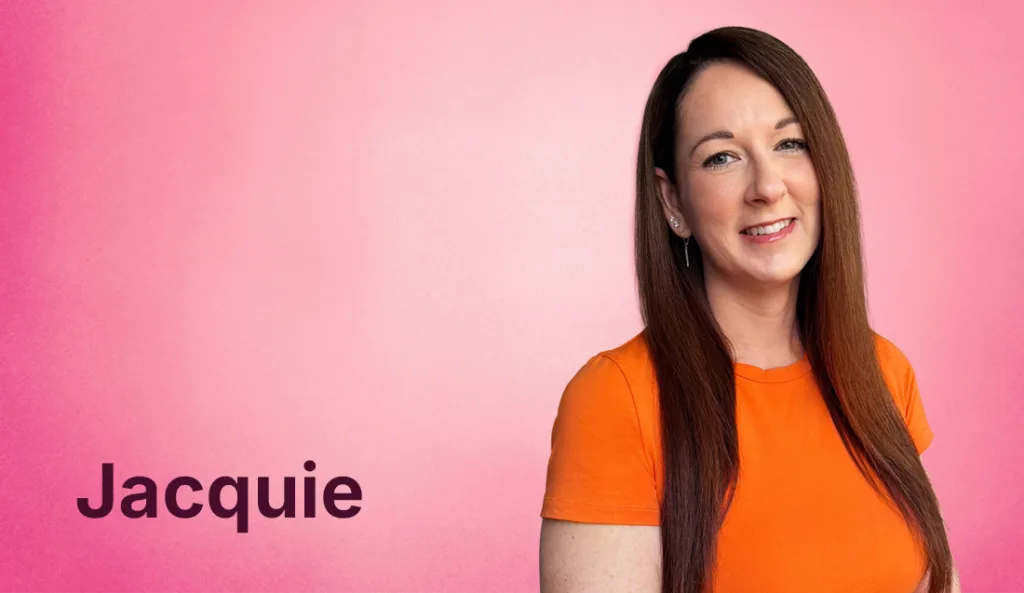
Jacqueline Matthews’ mother passed away in 2003 from breast cancer, nearly 20 years before Jacqueline herself received a life-changing diagnosis. Here’s how research has played a pivotal part in her story.
Jacqueline Matthews was just 16 years old when her mother was diagnosed with breast cancer in 1998. “Her breast cancer came back twice actually from her initial diagnosis,” Jacqueline remembers. In late 2002, “It had just spread everywhere, and there was nothing more that they could do,” she recalls.
Her mother died in 2003, just two months shy of her 50th birthday; Jacqueline was just 21 years old at the time. Losing her mother at such a young age left a mark. “I always had the idea of breast cancer possibility on my mind,” she says. “But you’re never ready for it when you’re told.”
At 41, nearly 20 years after her mother passed, Jacqueline realized she was three months overdue for a mammogram, so she made an appointment. “I was in and out; it was very easy,” she says. As it was her husband’s day off from work, he went with her to the appointment before they spent the afternoon together. “We went and had lunch, came home, and then I got a phone call saying that they needed me to come back the next day,” she remembers. As someone with dense breasts, it was normal for doctors to recommend following up with an ultrasound.
Further imaging and a biopsy revealed that she had hormone receptor-positive breast cancer, just like her mother. Despite hearing from doctors, “‘You need to stop thinking that you are going to have breast cancer because you’re too young,’” she says, “Literally four years later, I’m diagnosed with breast cancer.”
After the diagnosis came a “crazy whirlwind” of appointments and tests. Altogether, she had a breast MRI, CT scan, PET scan, and felt pushed towards a lumpectomy by her provider. But after seeing what her mother went through, she opted for a double mastectomy.
“I was diagnosed in September, had a double mastectomy in October, then started radiation in January, and had over 30 rounds,” she says. Though she originally decided on getting breast implants, she had implant illness, and ended up getting them removed.
“I feel so much better with the implants out,” she says, explaining that she then opted for DIEP flap, a type of breast reconstruction that uses skin, fat, and blood vessels from the lower belly to rebuild breast after a mastectomy or lumpectomy. “But that was never an option that was given to me in the beginning of my journey, and I just wish that was talked about more,” she admits.
As a general manager at Ulta Beauty, a Breast Cancer Research Foundation (BCRF) corporate partner, Jacqueline knows the impact of such an important partnership. In fact, Ulta Beauty and the Ulta Beauty Charitable Foundation have raised more than $67 million for BCRF. “I found out that a portion of the money that we raised during our annual fundraising campaign for BCRF supported research by Dr. Joseph Sparano, the lead investigator for the groundbreaking TAILORx clinical trial,” she says, and the results of that trial helped her care team decide that she could forgo chemotherapy. “So, in that moment, it was full circle,” she says.
Looking back, she attributes the difference between her journey and her mother’s to research. “Essentially, it’s given me time,” she says. “When I think about my mom…what if she was diagnosed today? Would she still be here?” she wonders, acknowledging she’ll never know. “I only got almost five years with her after her diagnosis.”
Now, she’s thinking of her future, and that of her daughter. “We’ve come so far,” she says. “I’m hoping that my children get me until I’m 98. And the only way we’re going to get there is through research.”