


At 45 years old, Jessica Conwell received a life-changing diagnosis that led her husband, Matt, to take action.
Jessica Conwell met her husband, Matt, at a college retreat in 1996. The pair married two years later and attended graduate school together near Portland, Oregon. They built a life centered on friendship, shared adventures, and unwavering support for one another—something that would soon be put to the test.
“We’re the kind of couple that are best friends and partners in the truest sense of the word,” he tells the Breast Cancer Research Foundation (BCRF). “There is absolutely nothing I wouldn’t do for her.”
In June 2022, Jessica, 45 at the time, went in for her annual mammogram. Later that evening, she received a phone call asking her to return for additional imaging. A biopsy revealed the news no family wants to hear: “You have cancer.”
Pathology showed that Jessica had triple-negative breast cancer, an aggressive subtype that accounts for approximately 10-15% of all breast cancer diagnoses.
“We knew nothing about triple-negative breast cancer,” Matt recalls. “The more I learned, the more frightened I became.”
Having watched multiple family members battle cancer, he immediately feared the worst.
“When I looked at the statistics, I thought I was going to lose her.”
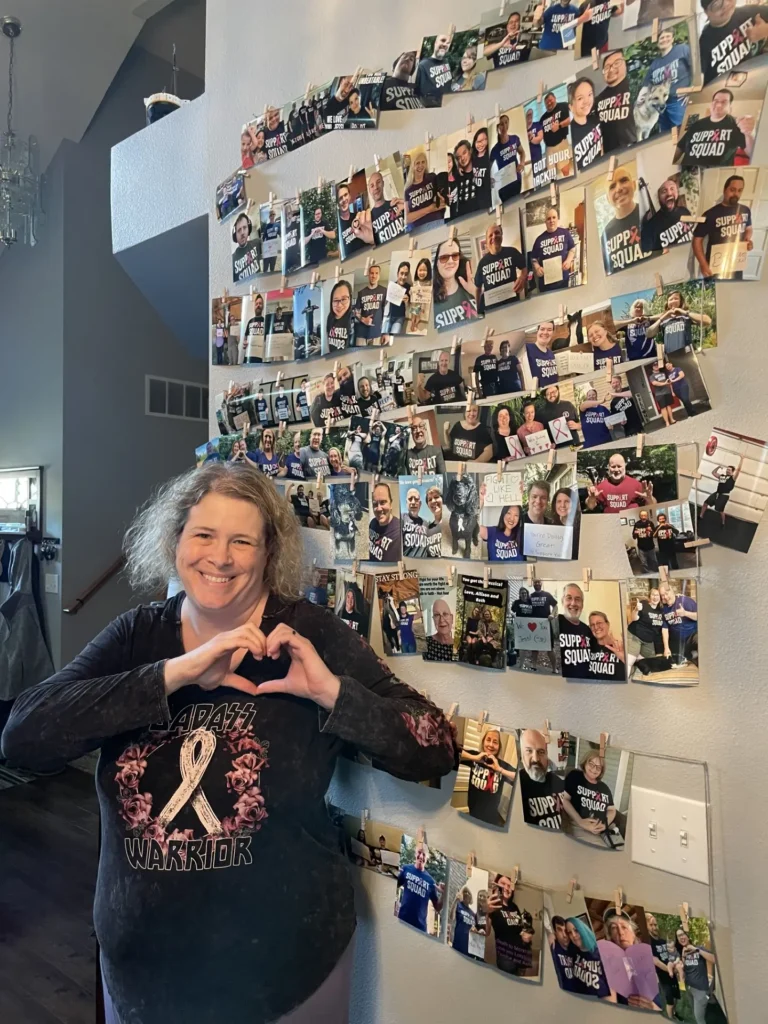
Jessica began treatment on August 1, 2022—the couple’s 24th wedding anniversary. Her breast cancer treatment plan included intensive chemotherapy followed by a double mastectomy in January 2023. Pathology results revealed that the cancer had spread to her lymph nodes, making additional treatment critical.
The pair would face even more challenges in the months to come. In April 2023, Jessica developed a rare and life-threatening bacterial infection called Fournier’s gangrene. She underwent emergency surgery and went into septic shock.
“At the time, I didn’t realize how serious it was,” Matt says. “Later, I learned that the medical team wasn’t sure she would survive.”
Jessica spent 61 days in the hospital and underwent multiple surgeries—all while continuing radiation for TNBC. Through extraordinary coordination between her care teams, she was able to stay on schedule with cancer treatment despite her prolonged hospitalization.
When she finally returned home, recovery continued for months. Matt became her primary caregiver. While much attention rightfully focuses on patients, Jessica’s husband believes caregivers often carry a heavy emotional burden that goes unseen.
“I cried daily for months,” he says. “I learned about anticipatory grief and how it can feel very similar to losing someone, even though they’re still here.”
He attended nearly every appointment and chemotherapy session through the duration of Jessica’s treatment. Every new symptom or hospitalization triggered fears that the cancer had returned, or that another crisis was on the horizon. “One family member reached out and asked, ‘I know everyone asks about Jessica, but what about you?’” He remembers. “It meant the world to me.”
Mental health challenges persist for breast cancer patients and caregivers alike. “There can be a stigma around men asking for help,” he says. “I wish everyone had someone they could talk to about the things they fear.”
Even now, four years after Jessica began treatment, Matt says the fear of recurrence remains a reality—long after active treatment ended. Long before cancer entered their lives, he had already built something remarkable: a community.
In 2003, while completing an MBA program, Matt created what would eventually become Portland Local Area Network (PDXLAN), one of the largest community gaming events in North America.
What started as a class project evolved into a four-day gathering that attracts 1,000 PC gamers from across the continent. Participants bring their computers, reconnect with friends, and celebrate a shared passion for gaming. But PDXLAN was always about more than games.

“I wanted to create a place where everyone was welcome,” he says. “A place of inclusion, respect, and community.”
Over the years, that community has become a powerful force for good. PDXLAN has supported numerous charitable organizations, raising funds and awareness for causes ranging from hunger relief and medical research to animal welfare and children’s health initiatives.
Jessica’s experience reinforced something he believes deeply: Research saves lives. Many of the therapies available to patients today simply did not exist a decade ago, particularly for those with TNBC.
“Those drugs are all based on scientific research,” he says. And in Jessica’s case, BCRF investigators and their teams were directly involved in developing some of her cancer treatments.
“To the scientists and doctors working on these breakthroughs: Thank you. You don’t know how much it means to families like ours.” Since 2017, PDXLAN has raised over $91,000 dollars for BCRF,” he says..
Today, Jessica moves forward with hope, resilience, and gratitude. For her husband Matt, every clean scan is a reminder of why research matters—and why communities like PDXLAN have the power to create meaningful change.
“Breast cancer is happening to women earlier than ever,” he says. “Researching it now helps save lives later. If not now, when? If not us, who?”
For families like theirs, the answer is clear: together, we can make a difference. To start your own fundraiser, click here!