


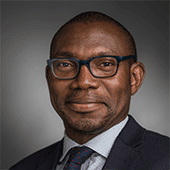
Titles and Affiliations
Assistant Professor, Medical Oncology
American Association for Cancer Research
Research area
Improving outcomes for breast cancer patients in Rwanda by reducing stigma around the disease.
Impact
The burden of breast cancer is rising in sub-Saharan Africa (SSA), where it is projected to become the leading cause of cancer mortality among women by 2030. Breast cancer treatment is increasingly available across SSA, yet a host of barriers prevent many women from accessing it. Breast cancer stigma has been identified as a major barrier and a primary reason why many SSA women are unwilling to receive curative breast cancer treatment. Both the cancer and related treatments such as mastectomy are heavily stigmatized in SSA, including in Rwanda, where patients often experience blame for their disease and survivors are ostracized within their families and communities. Dr. Fadelu’s work aims to develop effective interventions to reduce the drivers of breast cancer stigma and its impact on treatment uptake
What’s next
Dr. Fadelu is building upon his previous work that identified stigma experiences of patient and caregivers to create an intervention named RISE—Resilience, Support and Exposure to mitigate stigma for use with patients and their caregivers. He and his team aim to develop and prototype components of the RISE intervention using community-based participatory research methods to ensure diverse input in the development process, and to then assess implementation outcomes of the RISE stigma reduction intervention.
Biography
Temidayo Fadelu, MD is the Deputy Director of the Center for Global Health Equity in the Division of Population Sciences at the Dana-Farber Cancer Institute and an Assistant Professor of Medicine at Harvard Medical School. Dr. Fadelu’s research addresses global inequities in breast cancer. Originally from Nigeria, Dr. Fadelu completed college at Baylor University. He earned his medical degree from Yale University and completed internal medicine residency at the Hospital of the University of Pennsylvania. His medical oncology fellowship was at the Dana-Farber Cancer Institute, during which he also earned a master’s in public health at the Harvard T.H. Chan School.