

The latest advances across the continuum of breast cancer research
Key Takeaways
- Oral SERDs advance HR-positive care: New agents improve survival benefits and tolerability, potentially offering more treatment options for estrogen-driven disease.
- HER2-positive therapy evolves: Targeted, chemo-sparing regimens show promise in the first-line setting.
- ctDNA advances: Liquid biopsy is being tested to guide real-time treatment decisions.
- AI and risk-based screening to improve precision: Recurrence prediction enters the realm of personalized screening.
- TNBC treatment combinations gain momentum: PARP- and immunotherapy-based combinations deliver promising responses.
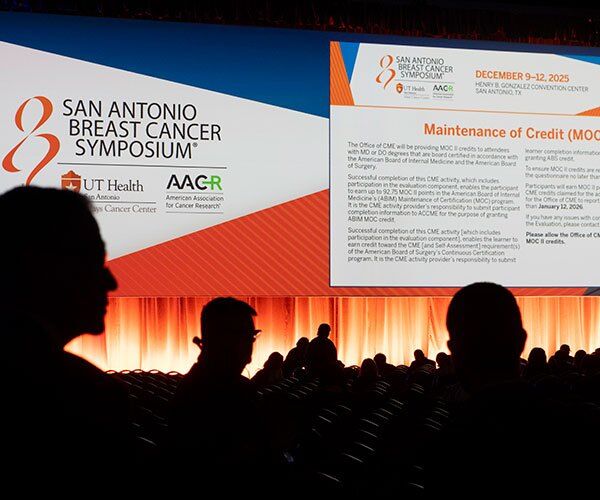
The San Antonio Breast Cancer Symposium (SABCS) is the largest global meeting devoted to breast cancer research. This year’s annual meeting had record attendance, with over 11,000 participants from 102 countries convening to share the latest news in the field. The program spanned the full breast cancer continuum, from prevention and diagnosis to therapy and long-term care. A large portion of the meeting focused on patient advocates and the important role they play in research.
Many BCRF investigators received awards and presented their work in major sessions throughout the conference. Clinical trial developments and treatment updates were some of the meeting’s biggest highlights; here is a look at a few hot topics.
New hormone therapy option and other developments in hormone receptor-positive breast cancer
Data from this year’s conference solidified the role of next-generation selective estrogen receptor degraders (SERDs) in the treatment of hormone receptor (HR)-positive breast cancer, including the next-generation oral SERD giredestrant, which prevented recurrence better than standard endocrine therapy and was better tolerated. Adding targeted therapies to oral SERDs may also halt treatment resistance, a major issue in endocrine therapy. Read about these exciting developments in more detail here.
These next-generation oral SERDs will help expand the treatment options for patients beyond fulvestrant, the first and only SERD that was available until 2023. Looking ahead, giredestrant could offer an option that is more effective, prevents recurrence, and is better tolerated, including for early-stage breast cancer. And the brain-penetrant oral SERD imlunestrant (Inluriyo®) could become a new primary endocrine-blocking therapy for patients with metastatic breast cancer or in combination with a CDK4/6 inhibitor for endocrine therapy-resistant breast cancers.
HER2-targeting treatments in the first-line setting
Dr. Erika Hamilton of Sarah Cannon Research Institute presented results from HER2CLIMB-05 (NCT05132582), a phase 3 trial evaluating the addition of tucatinib (TUKYSA®) to trastuzumab (Herceptin®) and pertuzumab (Perjeta®) as first-line maintenance therapy for patients with HER2-positive metastatic breast cancer who had completed chemotherapy. This study demonstrated that tucatinib in combination with trastuzumab and pertuzumab outperformed trastuzumab and pertuzumab alone in this patient population: There was a 36 percent reduction in disease progression and 8.6 months of progression-free survival. This suggests that tucatinib may be practice-changing as a maintenance therapy in the first-line setting for metastatic HER2-positive breast cancer.
The DESTINY-Breast09 trial (NCT04784715) is the first trial in over a decade to show significant improvement over the standard of care and could lead to a major shift in treatment guidelines and practice. Dr. Mothaffar Rimawi of Baylor College of Medicine presented the patient-reported outcomes from the trial which compared T-DXD (Enhertu®) plus pertuzumab to the standard-of-care regimen—trastuzumab, pertuzumab, and taxane chemotherapy—as first-line therapy for patients with HER2-positive advanced or metastatic breast cancer. Patients who received T-DXD plus pertuzumab reported better quality-of-life and fewer side effects than those receiving the standard of care. The patient-reported outcomes from DESTINY-Breast09 provide crucial context to the primary efficacy and safety results. The data show that T-DXD plus pertuzumab offers durable pain control and allows maintenance of physical function, outcomes that are comparable to the standard-of-care regimen. This signals a shift away from first-line taxane-based chemotherapy and offers a more targeted, effective, and better tolerated regimen for many patients.
Leveraging liquid biopsy technology in treatment planning and decision-making
Circulating tumor DNA (ctDNA), which can be detected in a liquid biopsy sample, can indicate how a breast tumor is responding to treatment, track changes that can be used to guide targeted treatments, and more. Reports at SABCS 2025 unveiled a landmark advancement in precision oncology: real-time ctDNA-guided treatment.
Highly anticipated results reported from the SERENA-6 trial by BCRF investigator Dr. Nick Turner demonstrated how ctDNA surveillance may be used during treatment. By analyzing ctDNA, researchers could detect the emergence of ESR1 mutations during first-line treatment. ESR1 mutations signal that the breast cancer is changing, allowing doctors to switch a patient’s treatment to a drug that’s effective regardless of ESR1 mutation status. In SERENA-6, participants were switched to the investigational drug camizestrant, which resulted in significantly improved outcomes in patients with HR-positive/HER2-negative advanced breast cancer. It targeted emerging ESR1 mutations before clinical progression.
Results of the PHERGuide study showcased the role of ctDNA in monitoring HER2-positive breast cancer treatment to determine disease status in real time and personalize treatment accordingly: They revealed a significant correlation between ctDNA decrease and pathologic complete response (pCR) in patients with HER2-positive early breast cancer undergoing neoadjuvant HER2-targeted therapy.
Our understanding and clinical use of ctDNA is rapidly evolving, with more and more research geared towards maximizing its utility in the clinic. Ongoing research will expand our ability to pair highly accurate diagnostics (such as ctDNA analysis) with highly effective therapies to sustain the momentum towards a new era of personalized medicine for patients with breast cancer.
The WISDOM trial demonstrates that risk-based breast cancer screening is as safe as annual screening
Individual breast cancer risk can guide when screening should begin, how often it should take place, if any supplemental imaging is needed, and if any preventive measures should be considered. The WISDOM trial (NCT02620852), a study with over 45,000 participants, evaluated whether this type of risk-based breast cancer screening is an acceptable alternative to annual mammography.
The trial’s risk-based breast cancer screening model looked at screening frequency, modality, risk-reduction counseling, and population-based genetic testing to tailor an individual’s risk. The model safely reduced the number of later-stage diagnoses and estimates indicate that it could reduce 4,000-5,000 deaths annually. The 10-year results of the trial showed that risk-based breast cancer screening offers patients safer alternatives to annual mammography based on their individual risk, provides cost savings, and advances precision prevention.
The WISDOM trial results were simultaneously published in the prestigious journal JAMA.
New combination treatments for patients with TNBC
Updates in the TBCRC-056 and OlympiaN clinical trials for triple-negative breast cancer (TNBC) brought encouraging advances for patients with inherited BRCA mutations and early-stage disease.
The TBCRC-056 trial, supported in-part by BCRF, evaluated a chemotherapy-free neoadjuvant regimen combining the PARP inhibitor niraparib (ZEJULA) with the anti–PD-1 immunotherapy dostarlimab (JEMPERLI) in patients with germline BRCA1/2 or PALB2–mutated, HER2-negative breast cancer. Dr. Erica Mayer of Dana-Farber Cancer Institute presented the results, which revealed that 50 percent of study participants achieved pCR on the two drugs. This combination is therefore a promising new non-chemotherapy option that can be delivered before surgery for triple-negative disease.
The OlympiaN trial is investigating the combination of the PARP inhibitor olaparib (LYNPARZA®)in combination with the immunotherapy drug durvalumab (IMFINZI®) in patients with BRCA1/2 mutations and high-risk, HER2-negative or TNBC. Results revealed that 80 percent of study participants achieved pCR with the combination, suggesting a potential shift towards chemotherapy-free treatment options for TNBC. This trial is part of a broader effort to explore innovative treatment strategies for TNBC, reflecting the evolving landscape of breast cancer care.
Newer treatment combinations also continued to improve outcomes in metastatic TNBC. The ASCENT-04 (NCT05382286) trial showed that pairing immunotherapy with the targeted antibody-drug conjugate (ADC) sacituzumab govitecan (TRODELVY®) delayed cancer growth longer than chemotherapy plus immunotherapy, pointing to a new and more effective option for advanced TNBC.
Together, these findings signal a shift toward more personalized, targeted, and potentially less toxic treatment options across TNBC—a welcome result for patients with this difficult-to-treat subtype.
BCRF investigators honored for groundbreaking work
BCRF proudly acknowledges two of our investigators who received awards at SABCS 2025.
Dr. Ben Ho Park received the 2025 AACR Distinguished Lectureship in Breast Cancer Research, which honors outstanding scientists who have inspired new perspectives on the causation, diagnosis, treatment, or prevention of breast cancer. He received this award in recognition of his groundbreaking research that has transformed our understanding of breast cancer at both the molecular and clinical level. His work has defined how PI3K/AKT signaling becomes deregulated during tumor progression, providing critical insights into treatment resistance, invasion, and metastasis. Notably, Dr. Park pioneered the use of ctDNA as a minimally invasive biomarker. This approach has revolutionized precision cancer medicine by enabling clinicians to detect genetic mutations, monitor disease progression, and track minimal residual disease in patients with breast cancer, in turn making it possible to identify metastatic potential in early-stage patients before disease progression.
Dr. Sara M. Tolaney received the 2025 AACR Outstanding Investigator Award for Breast Cancer Research, supported by BCRF. This award recognizes an investigator whose novel and significant work has had or may have a far-reaching impact on breast cancer. Dr. Tolaney’s pioneering work is dedicated to optimizing targeted therapies through innovative clinical trials that have changed treatment guidelines for countless patients. Her body of work has shaped precision oncology in breast cancer and improved many patients’ lives. She led a key trial that demonstrated a less intensive treatment regimen—paclitaxel (Taxol®) and trastuzumab—was effective for early-stage, node-negative HER2-positive disease. These results transformed national and international clinical treatment guidelines and shaped the future of precision oncology for patients with breast cancer.

