

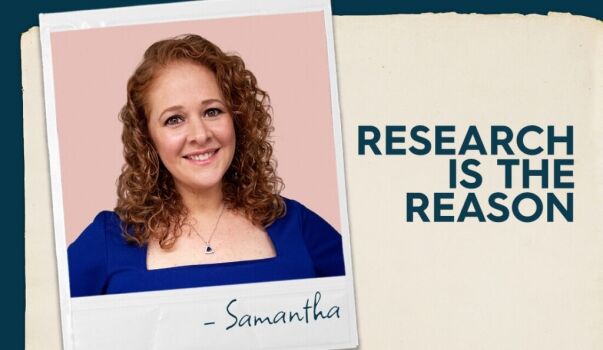
Samantha Golkin-Nigliazzo, vice president of The Pink Agenda, wants all women—including her daughter—to feel empowered to take control of their breast health
Though Samantha Golkin-Nigliazzo was diagnosed with ductal carcinoma in situ (DCIS) when she was 30 years old, her experience with breast cancer really started when she was only five. That was when her mother, Judy, learned she had inflammatory breast cancer—a particularly fast-growing and aggressive form—two weeks after giving birth to her youngest child.
“She was given a very short time to live as treatment options, particularly in 1988, were fairly limited,” Samamtha said. “She was 33 years old and had three kids under the age of six, and that was the news she was given. But she was a strong, resilient woman. She always had a smile on her face.”
Judy lived for two years after her initial diagnosis, ultimately passing away when Samantha was seven. That devastating loss shaped Samantha’s life.
From an early age, Samantha’s parents stressed the importance of staying on top of her health and knowing her risk of breast cancer. Samantha first started seeing a breast specialist when she was 15 after noticing a lump under her armpit that turned out to be an inflamed lymph node. That doctor taught her to do self-exams and be vigilant about any changes in her breasts.
“Even as a young girl, I was very much aware of everything going on in my body because I was told to be on top of your health,” Samantha said. “I felt empowered by the education. As somebody who’s very keenly aware of her risk, my whole life has been about knowledge and education.”
Samantha began getting annual mammograms at 23—starting 10 years before the age Judy was diagnosed. Even with doctor’s orders and her significant family history, for years Samantha had to fight to be screened and pay for the procedure out of pocket. Finally, a sympathetic radiologist told her: “It doesn’t have to be this hard. There are programs for people like you.”
Samantha joined a high-risk surveillance program at Memorial Sloan Kettering in New York City a few months before her wedding to her now husband, David.
“It was a really good time to start this program, because I was at that juncture of life with lots of changes,” she said.
The program’s specialists ordered a baseline mammogram and MRI scheduled two months apart. Samantha’s mammogram showed no suspicious findings. On the MRI though, doctors spotted something. A biopsy a week later confirmed there were malignant cells in her breast, and Samantha was diagnosed with DCIS. DCIS is also known as stage 0 breast cancer because it’s considered the earliest form of the disease. Though it is non-invasive, it can progress to become invasive disease (stages 1-4).
“I was expecting a diagnosis. But the question was: Did I catch it early enough? Because that was always my goal. Breast cancer wasn’t an if for me; it was a when,” Samantha said. “I was shocked that I had to deal with this at a very pivotal time in my life, but I felt empowered. I advocated for myself for years. And at this very vital period in my timeline in my life, I was able to identify the problem and attack it in the most aggressive way.”
Samantha credits research for the fact that she was diagnosed with the earliest possible stage of breast cancer, but also for the ability to choose from a few options for treatment: breast-conserving lumpectomy and radiation or a mastectomy. With her family history, she opted to have a double mastectomy to drastically reduce her risk—even though the timing could not have been more inconvenient.
“I wanted to start my new life with my husband as healthy as possible,” she said. “There was a sadness in having to put my marathon training on hold and talk to my husband. While most brides were shopping for lingerie, I was shopping for surgical bras. But I have the most supportive husband, and he was there with me the whole way.”
As part of the high-risk surveillance program, Samantha, who is of Ashkenazi Jewish ancestry, underwent genetic testing, which showed she had no known mutations associated with breast cancer.
“I was surprised by that,” she said. “There’s got to be some kind of genetic or familial predisposition that is causing me and other family members to be diagnosed, but we don’t know. I’m still a genetic abnormality. The question is: When will research find it?”
Shortly after Samantha underwent her double mastectomy, she reached out to The Pink Agenda (TPA), a nonprofit for young professionals that’s dedicated to raising awareness and funds for research through BCRF.
“I remember sitting on my couch; I had surgical drains coming out of me, but I knew I was going to be OK. This was going to be just another step along the road of life,” she said. “But I needed to give back. I needed to take all the knowledge I’ve gained and my experience and use that for good.”
Samantha joined TPA’s Board of Directors in 2014, and over the last decade, she has been instrumental in helping the nonprofit reach new audiences and educate young women about breast cancer. She helped start TPA’s education committee in 2015 and, with TPA president Nicole Seagriff, launched the organization’s speaker series, traveling to colleges and businesses to talk about her personal experience with breast cancer and share information about the disease. More recently, Samantha helped launch TPA Talks and TPA Supper Club, the latter with the late TPA board member Samantha Shoobs. In the midst of this, she even earned a master’s degree in positive psychology to help her educate others.
“I think that everybody needs some purpose,” she said. “You have your career and then you have your calling, and this has been mine. I want people to be empowered by research. That’s really it.”
That includes her nine-year-old daughter and six-year-old son. Samantha says all her work and advocacy is fueled by a desire to change how future generations experience breast cancer.
“I’m not doing this for me anymore. I’m doing it for my daughter and son and my sister, who is also high risk. Because we should know what’s going on in our bodies. And I want my daughter to have power,” she said. “What we do now impacts the future. Research and having knowledge will transcend generations.”
Samantha is a passionate champion of breast cancer research especially at this moment, when rates of the disease are rising among younger women.
“I don’t know if I would be here without research,” she said. “I would not have been educated about breast cancer. I would not have benefitted from screening tools that identified breast cancer at its earliest possible stage. The options and choices I had were all due to research. My family and I will benefit more in the future as more genetic predispositions are identified and tested. Research lets you take action, and that is powerful for every woman.”
Read more stories from BCRF’s Research Is the Reason storytelling initiative here.

