

BCRF researchers shared updates and insights on advancements in breast cancer research on pregnancy, AI, exercise, and more
On October 16, the Breast Cancer Research Foundation (BCRF) honored our over 280 researchers at this year’s Symposium and Awards Luncheon, held in New York City.
Among the over 200 BCRF researchers present at the event, this year’s luncheon honored Karen and Rob Hale, who donated $50 million to BCRF in the largest single gift ever made to breast cancer research, and BCRF researcher Dr. Kornelia Polyak, who was presented with the Jill Rose Award for Scientific Excellence.
Former star of the Bachelorette Katie Thurston, and her husband, comedian Jeff Arcuri, led a Text-to-Pledge fundraiser, during which Katie, who has metastatic breast cancer, or stage 4, first publicly announced that she now has “no evidence of disease.”
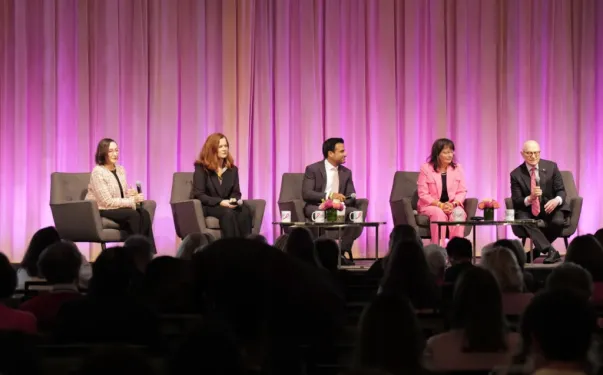
This year’s symposium, “How Studying Early-Onset Breast Cancer is Helping Women of All Ages,” featured a conversation with BCRF researchers Drs. Neil Iyengar, Ann Partridge, and Kornelia Polyak.
The panel was moderated by BCRF Founding Scientific Director Dr. Larry Norton, Memorial Sloan Kettering Cancer Center, and Scientific Director Dr. Judy E. Garber, Dana-Farber Cancer Institute and Harvard Medical School.
Ahead, learn some of the key takeaways from this year’s Symposium panel discussion.
1. Research on breast cancer during and after pregnancy picks up momentum
Panelists spoke extensively on the progress of breast cancer research during and after pregnancy, which has been invaluable not only for patients who are hoping to become pregnant, but for scientists studying general breast cancer prevention and treatment.
Dr. Partridge referenced the promising results of the BCRF-supported POSITIVE trial, on which she was the lead investigator, which studied whether patients could take a break from hormone therapy, which is not compatible with pregnancy, to become pregnant. The results found that, with clinical support, patients could ultimately stop treatment for up to two years, and that pregnancy was not driving recurrence. The findings address a major clinical dilemma often faced by patients with hormone-receptor positive breast cancer.
Researchers like Dr. Polyak are also examining how immune tolerance during pregnancy and changes associated with breastfeeding may affect breast cancer development. This may have an impact on breast cancer research more generally. The accumulation of immune cells in the breast during breastfeeding and pregnancy can help protect against the development of triple-negative breast cancer, and scientists hope further study will help them recreate these protective effects in individuals who are not pregnant or breastfeeding.
“What we’re learning about pregnancy is also bridging into what we’re learning about biology in ways [that help us to] understand breast cancer better for prevention and therapy,” Dr. Norton said during the symposium.
2. AI screening tools—and data sharing—accelerate breakthroughs
Researchers expressed optimism on the progress of artificial intelligence (AI) in both breast cancer detection and data collection.
Dr. Norton referenced BCRF researcher Dr. Constance Lehman’s work on AI-powered screening tools to help identify patients who may develop breast cancer through Clairity Breast. These risk assessment tools have been incorporated into the NCCN 2026 research guidelines, and investigators are now working to ensure equitable access for all women across the country.
BCRF Chief Scientific Officer Dr. Dorraya El-Ashry also pointed to the hope for AI-powered multimodal models to further analyze research from sources like the BCRF Global Data Hub, created in partnership with the University of Pittsburgh. AI may help researchers look at every “bit of individual data,” said Dr. El-Ashry, and allow researchers to ask more detailed questions.
3. GLP-1s continue to be a hot topic
Researchers emphasized that there is not yet enough long-term data—or conclusive studies—on GLP-1s and breast cancer, pointing to conflicting data on whether it actually has an ability to lower the risk of certain cancers.
Dr. Iyengar discussed how a more nuanced understanding of the relationship between obesity and cancer is shaping current research. This evolving research is helping guide questions about weight loss and the potential role of GLP1-s in mitigating breast cancer risk. He emphasized the importance of studying body composition, citing findings that indicate the association between obesity and increased breast cancer risk is not quite as “black and white” as previously thought.
According to the conversation during the symposium, researchers are focused on the direct effect of GLP-1 medications on cancer biology and immune function. “For now,” said Dr. Iyengar, “we’re studying how these drugs might be leveraged or part of our toolkit for leveraging survival for breast cancer patients.”’

4. Exercise is a key lifestyle factor that is often overlooked
Panelists agreed that data on potential lifestyle and environmental predictors of breast cancer remain murky. But moving beyond broader categories—like body mass index (BMI)—may help scientists better understand how individual cells, immune responses, body composition, and biological aging influence breast cancer. Dr. Iyengar emphasized the importance of studying body composition both as a marker of risk and as a way to help inform specific types of lifestyle interventions.
Panelists emphatically agreed on the proven importance of exercise in mitigating breast cancer risk. Drs. Iyengar and Polyak pointed to studies on cellular aging that indicate one’s numerical age and their biological age are not always the same—and that exercise may help change this. Dr. Iyengar noted that he has seen the “largest biological changes” in people who are taken from a sedentary lifestyle to an active one during clinical trials.
5. Investments in innovative research and health equity are critical to progress
Throughout the discussion, panelists shared their gratitude for BCRF’s support of previously unfunded research initiatives. Dr. Polyak remarked that her research on heterogeneous tumors was seen as “not worth studying” decades before it was finally funded. Dr. Iyengar emphasized how in research, initial ideas that were considered “unfundable” are now funded and “mainstream.”
In addition, researchers are increasingly focused on providing information and support for underserved communities and closing the gap in diagnoses and treatment. BCRF-supported programs like the Global Data Hub and the Health Equity Initiative are helping investigators centralize data and uncover both the social and biological factors underlying disparities in breast cancer outcomes.

