
New guidelines from the National Comprehensive Cancer Network® champion artificial intelligence in breast cancer screening
Key Takeaways
- New NCCN guidelines introduce AI-based risk assessment using mammograms to predict a woman’s 5-year breast cancer risk
- Risk assessment via mammogram to begin at age 35, marking a major shift toward earlier identification and intervention
- A ≥1.7% 5-year risk threshold is now used to define “increased risk” and guide clinical action
- Most women who develop breast cancer are not identified by traditional methods—this guideline helps close that gap
- Screening evolves from detection to prediction, enabling more personalized prevention strategies
- Risk is no longer static—guidelines call for ongoing reassessment over time
Breast cancer incidence has been on the rise for decades. Alarmingly, the disease is impacting younger women with incidence rising at double the rate for women under 50 as compared to women over 50, with the steepest incline seen in women under 40.
But most women who develop breast cancer are never flagged as high risk. Almost 90 percent of breast cancer patients have no significant family history or genetic mutation. Traditional risk assessment models—like the Tyrer-Cuzick model or the Gail model—rely heavily on these factors. While these models have undoubtedly saved lives and continue to be important tools to assess lifetime risk, their limitations leave a glaring gap—missing a large portion of women who are ultimately diagnosed with the disease.
That reality may finally be changing.
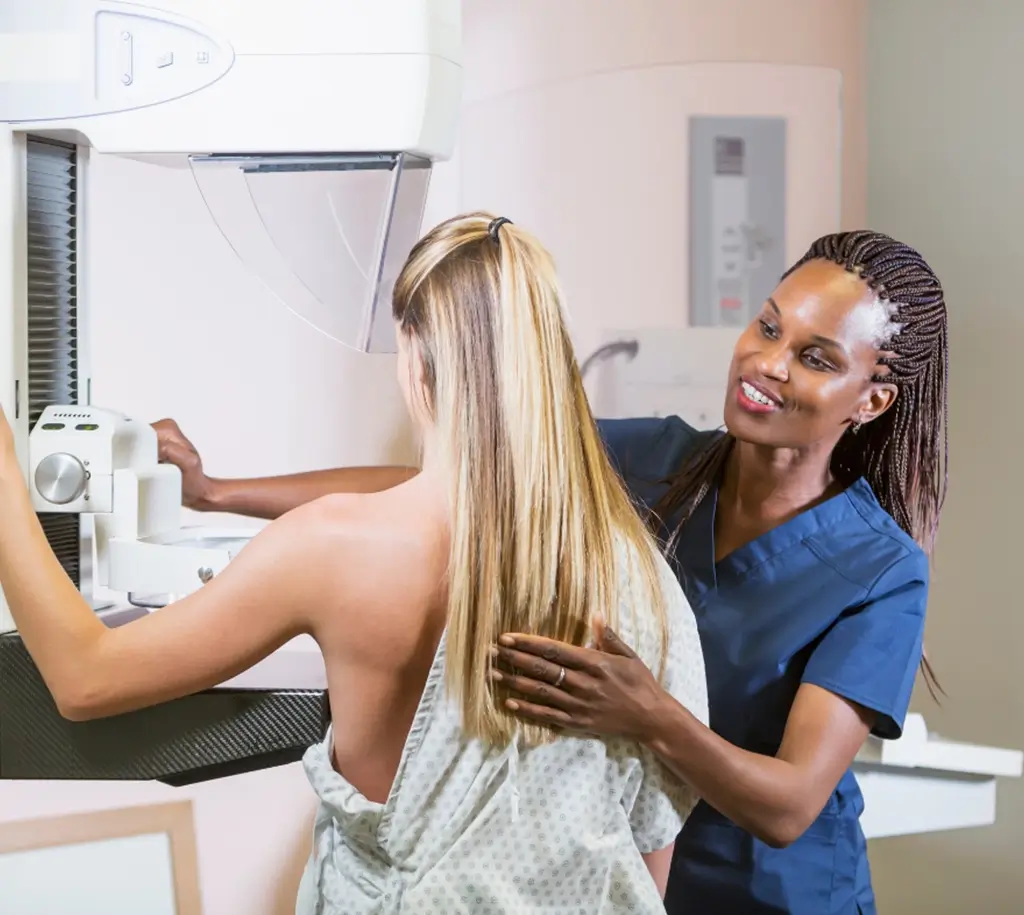
In a significant update, the National Comprehensive Cancer Network® (NCCN®) has introduced a risk assessment option in its 2026 NCCN Clinical Practice Guidelines in Oncology for Breast Cancer Screening and Diagnosis—one that uses artificial intelligence to assess a woman’s future risk of developing breast cancer based on her mammogram. Notably, the updated guidelines recommend beginning AI mammogram-based risk assessment at the age of 35. By harnessing a tool that can find the needles in the haystack with lifesaving precision, younger women in particular stand to be armed with the knowledge of their true risk of breast cancer.
It’s a fundamental shift in how risk is defined, and who gets attention.
BCRF-funded Clairity Breast is the first FDA-authorized AI platform to use a single mammogram to predict five-year risk. It is poised to change the future of breast cancer prevention.
“It’s encouraging to see advances in breast cancer risk assessment beginning to reach clinical care, including AI-based approaches that may help identify higher-risk women earlier—particularly those under 50 who might otherwise go unflagged,” said BCRF Scientific Director Dr. Judy Garber. “While continued research and real-world evaluation are essential, these tools represent a meaningful step toward more personalized screening and prevention. The inclusion of AI-informed risk assessment in NCCN guidelines reflects BCRF’s growing confidence in this approach and underscores the impact that sustained research investment can have on improving care.”
Simultaneously, other BCRF-funded research—such as the WISDOM trial—offers an approach to screening recommendations based on lifetime risk scores. The 10-year results of the WISDOM trial were recently reported, showing that risk-based breast cancer screening offers patients safer alternatives to annual mammography based on their individual risk, provides cost savings, and advances precision prevention.
From Detection to Prediction
Traditional screening asks a simple question: Do you have breast cancer right now?
The new AI-based approach asks something far more powerful: What is your risk of breast cancer in the next five years?
Using imaging data already captured during routine mammograms, AI models can now identify subtle patterns linked to future breast cancer risk—signals that are invisible to the human eye. The NCCN guidelines formally incorporate this capability, introducing a 5-year risk threshold (≥1.7%) as a trigger for action.
That action may include supplemental imaging, closer monitoring, or preventive strategies.
In other words, screening is no longer just about finding breast cancer. It’s about intercepting and potentially preventing it from happening in the first place.
Earlier, Smarter Intervention—Starting at 35
One of the most significant shifts: the guidelines expand mammography for risk identification to begin at age 35.
Currently the United States Preventive Services Task Force recommends average-risk women begin mammography at the age of 40. But the purpose of that recommendation is fundamentally different: The shift towards prevention is the key driver of the NCCN guidelines.
By identifying increased risk earlier, clinicians have a wider window to intervene, before disease develops or progresses.
Equally important, the guidelines emphasize that risk is not static. They recommend periodic reassessment, acknowledging that a woman’s risk evolves over time. This introduces a more dynamic, responsive model of care—one that adapts rather than reacts.
Closing the Biggest Gap in Breast Cancer Risk Assessment
For years, the gold standard of risk assessment has centered on genetics—mutations like BRCA1 and BRCA2—and strong family history. These tools are essential, especially to calculate lifetime breast cancer risk, but they identify only a fraction of women who will ultimately develop breast cancer, and they don’t generalize well for women of color.
Additionally, the latest report from the WISDOM trial found that 30 percent of women who tested positive for a genetic variant did not report having significant family history—a clear signal that family history is not a clear identifier for who should undergo genetic testing and that many women are unaware of their genetic risk.
In other words, until now, most high-risk women were largely invisible.
These are women who appear to be of average risk on paper but carry hidden biological signals of future disease. By leveraging AI to analyze mammograms, clinicians can begin to identify risk in this broader population.
This is not just an incremental improvement. It addresses one of the most persistent blind spots in cancer prevention.
Where Can Women Access AI-Powered Mammograms for Risk Assessment?
Clairity Breast announced the first patients to receive their AI mammogram-based risk assessment at Beth Israel Deaconess Medical Center in February of this year. And other centers are in line to launch: Women in Colorado will have access through Invision Sally Jobe Radiology Imaging Associates in late spring; Emory Healthcare in Atlanta, GA will be offering Clairity Breast to their patients this summer.
In the meantime, these NCCN guidelines and patient demand will move the needle toward encouraging adoption of these AI-powered tools across the country. Clairity Breast is currently the only commercially available source for AI-based mammography for risk assessment and can only be accessed through the healthcare systems mentioned above.
The Opportunity and the Challenge
Guidelines alone do not change outcomes. Implementation does.
With the NCCN offering new recommendations, the movement to push for AI mammography-based risk assessment will help move the needle for expanded:
- guideline adoption across clinics,
- insurance coverage through policy changes, and
- adoption of AI platforms like Clairity Breast at imaging centers.
If done right, this could signal a turning point—one where more women are identified earlier, monitored more closely, and spared from disease.
A New Era: Precision Prevention
What the NCCN has effectively endorsed is the concept of precision prevention.
Instead of applying broad screening rules to entire populations, clinicians can now tailor strategies based on individualized risk—continuously updated and grounded in real data.
The implications extend beyond the clinic:
- Health systems may redesign screening pathways.
- Payers may rethink coverage for supplemental imaging.
- Patients may gain a clearer, more actionable understanding of their risk.
But perhaps the most profound impact is conceptual.
For the first time, a routine mammogram is not just a snapshot of the present—it becomes a window into the future.
“For decades, we’ve known that the mammogram contains critical information—not just about the presence of cancer, but about a woman’s future risk,” said Connie Lehman, MD, PhD, Professor of Radiology, Harvard Medical School (on leave), Founder and CEO of Clairity, Inc. “Advances in AI now allow us to extract that information in a clinically meaningful way. This is the foundation on which we developed Clairity Breast—the FDA-authorized, imaging-based AI model that provides five-year risk assessment at the point of care—helping make more precise, individualized risk-based care accessible to far more women.”
These advances in precision prevention, such as Clairity Breast and the WISDOM trial, offer a future where patients can determine screening based on their personal risk—both lifetime risk and incremental five-year risk. Together, these approaches will improve early detection and, importantly, prevent the disease from taking root entirely.
“A core tenet of BCRF’s research funding model is to support the world’s most innovative science—not only to advance treatment, but to prevent disease altogether,” said BCRF President and CEO Donna McKay. “As supporters of Clairity Breast and many research projects focused on intercepting breast cancer before it takes root, we’re seeing advances in precision prevention begin to move from research into care—progress that reflects years of investment in bold ideas. It’s a powerful reminder that the breakthroughs we fund today have the potential to change outcomes not years from now, but in real time.”
-Scientifically reviewed by Priya Malhotra, PhD