

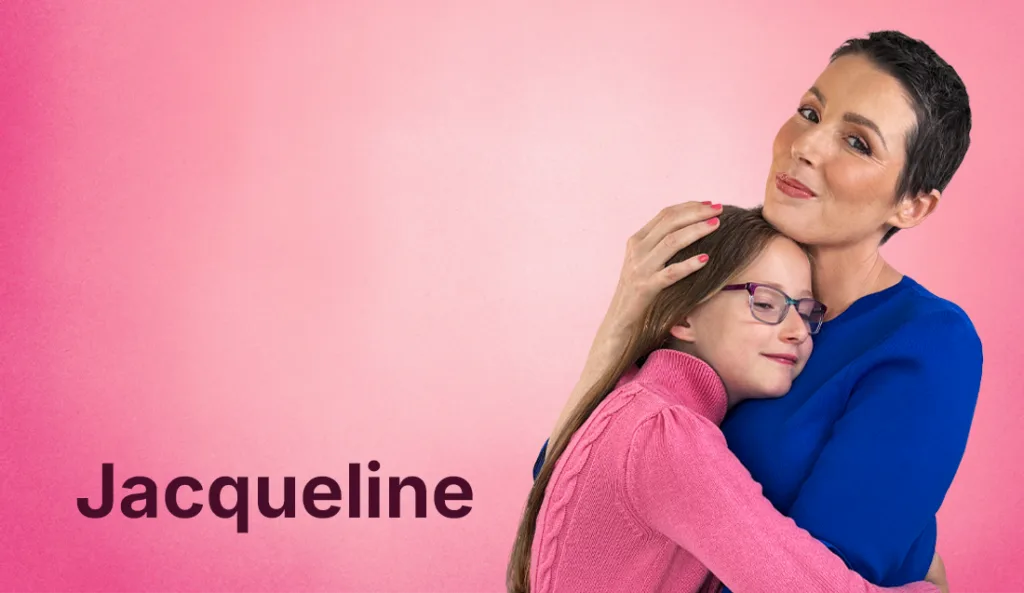
The meteorologist says research is the reason she’s survived cancer twice
In 2017, Jacqueline Bennett was riding high. She was relishing every second as a new mom to her son, John, who had just turned 4 months old. Her career in TV meteorology was taking off: She had a new job in Boston and was on a network news trajectory. She had also just discovered she was pregnant again.
But this joyous time quickly turned harrowing when she found a lump in her breast while breastfeeding. While three doctors brushed it aside, Jacqueline’s new OB-GYN was concerned and moved quickly. She had a biopsy on Friday and the results on Monday: triple-negative breast cancer, a notoriously difficult subtype of the disease to treat. Jacqueline was just nine days pregnant with her daughter.
“Had I not been pregnant and gone to see this particular doctor, I might not be sitting here today,” she says.
Because significant fetal organ development happens in the first trimester of pregnancy, Jacqueline started chemotherapy in her second. She worked with a maternal-fetal medicine specialist who was skilled at caring for pregnant women with breast cancer.
Jacqueline had surgery to remove the cancer and then chemotherapy to target any lingering cells. She was in treatment up until two weeks before her daughter Grace was born in February 2018, weighing in at just five pounds. Even though her growth had been restricted by chemotherapy, she was healthy and went home three days later.
“She was tiny, but mighty,” Jacqueline says. “And now she’s a feisty eight year old.”
After Grace was born, Jacqueline had more than 30 rounds of radiation. She went back to work, but shortly after moved with her family back to their home state of California. Jacqueline knew that recurrence rates for triple-negative breast cancer were high within the first five years of diagnosis, and she wanted to be close to home so that, if needed, she could “spend all my precious time with my babies and my family,” she recalls. Thankfully, the cancer didn’t recur, and Jacqueline moved to a more staggered screening cadence: a mammogram or an MRI every six months.
In September 2024, Jacqueline went for her usual mammogram and advocated for an expedited MRI because she had pain in her left breast. In December, the MRI she pushed for picked up an abnormal finding, but the report classified it in the “probably benign” category. But at her next MRI in July 2025, that “probably benign” spot had doubled in size. After another biopsy and more testing, Jacqueline learned in August that she had HER2-positive breast cancer—an entirely different breast cancer than the one she had eight years prior. Thankfully, HER2-positive breast cancer responds quite well to treatment, and she was able to start medications before surgery (neoadjuvant treatment). By her third infusion, the treatment wiped out the cancerous cells. Encouraged by these results, Jacqueline’s doctor allowed her to drop one of the two chemotherapies she was on for the last two rounds of treatment. Jacqueline credits the medications for her success, of course, but she also considers her positive attitude essential.
“I felt like mindset is so important,” she says. “I was like, okay, let’s go. Let’s do this. I knew from the get-go, I’m having a complete response. This is never coming back.”
Jacqueline next had a lumpectomy which confirmed she had had a pathological complete response (pCR), meaning no cancer cells remained, followed by a full mastectomy 10 days later. The surgeon saw that Jacqueline had atypical lobular hyperplasia, a group of abnormal cells that is a precursor for breast cancer.
“If I had not done the mastectomy, I would have ended up with a third type of breast cancer eventually, which is insane,” she says.
Surprisingly, genetic testing did not reveal any cancer-causing mutations. But Jacqueline did have two variants in the MTHFR gene, which regulates folate and may impact how the body clears bad cells. No one is exactly sure why Jacqueline was so prone to breast cancer, but her doctors have a theory.
“I may have had a field of abnormal tissue more prone to developing cancer called field cancerization,” she says. “It was impossible to know that having done a lumpectomy the first time; the mastectomy provided a more complete picture of that field of tissue.”
Today, Jacqueline remains on targeted therapy and is managing the lingering side effects of treatment, like medical menopause. She also recently had a breast infection that set her physical therapy efforts back, though she was recently cleared to exercise again.
Although she was hesitant to share her story on social media the first time, she was ready to speak about it when she faced cancer a second time. She’s since become an advocate in the breast cancer space, with more than 4,000 Instagram followers.
“It’s almost cathartic for me and for [those who follow along],” she says. “And to be under the care that I’m under now—the world-class care and advice that I have gotten—I want to share that with people.”
She’s quick to extol research as essential to her healing, especially from her second bout with cancer. In the 1990s, HER2-positive breast cancer had extremely low survival rates; now, thanks to new treatments, it is one of the most survivable forms of the disease.
“That took it from being a very grim, scary, dismal thing to [me being] optimistic from the start,” she says. “I make donations to BCRF because I want that research to be made so that people don’t have to lose their lives over this. I don’t want any woman to ever be told, ‘We have nothing left for you.’”
After surviving breast cancer twice, Jacqueline is intent on using her experience for good. She’s a strong proponent for early detection, knowing your risk factors (especially if you have dense breasts, which can make it harder to spot cancer on a mammogram), advocating for yourself, and supporting science.
“We are making advancements every single day,” she says. “And if, God forbid, this comes back in five, six years, or whatever, we’re going to have more options then. And I just want that for everybody.”