


Learn about the remarkable progress BCRF researchers and others are making to expand treatment strategies for these patients
Key Takeaways
- At the 2025 San Antonio Breast Cancer Symposium, researchers presented encouraging findings on hormone receptor (HR)-positive breast cancer.
- New oral selective estrogen receptor degraders (SERDs) show strong potential.
- Adding CDK4/6 inhibitors to endocrine therapy also had positive impact.
- Combining radiation and immunotherapy could mobilize the immune system to fight cancer.
- AI could help make better recurrence predictions.
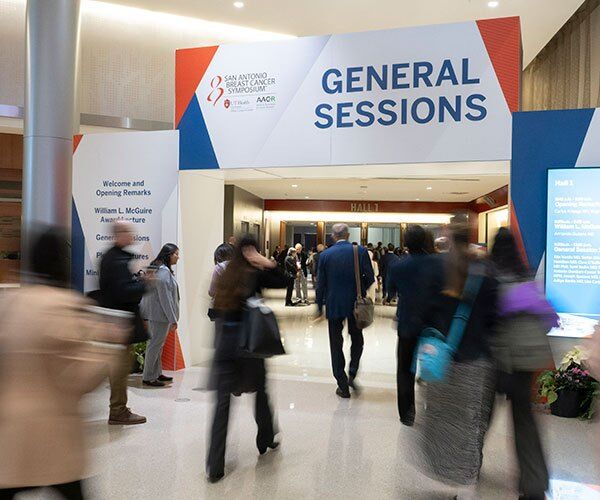
The 2025 San Antonio Breast Cancer Symposium (SABCS) showcased progress in breast cancer research across the continuum of the disease. Several reports from BCRF investigators and others highlighted treatment advances for hormone receptor (HR)-positive breast cancer. Read on for the most recent developments.
Next-generation oral SERDs show promise
Giredestrant
Next-generation selective estrogen receptor degraders (SERDs)—the newest of which is giredestrant—received considerable attention.
BCRF investigator Dr. Aditya Bardia presented exciting results from the lidERA (NCT04961996) phase 3 clinical trial which tested giredestrant in hormone receptor (HR)-positive breast cancer. Dr. Bardia and his colleagues found that giredestrant had clinically significant improvement in invasive disease-free survival over standard of care. And, over three years, it showed superior benefit in preventing recurrence—a 31 percent decrease in risk of distant recurrence—over standard endocrine therapy in HR-positive breast cancer, including early-stage. It’s the first SERD to show superior benefit over standard endocrine therapy in preventing recurrence in early-stage HR-positive breast cancer. Additionally, giredestrant was also better tolerated than current treatments, which means that it would be easier for patients to stay on long-term. Dr. Bardia and his team will continue to follow these positive early trends. Giredestrant’s “fast track” approval status from the FDA coupled with the lidERA trial results will likely result in faster approval, moving it to the clinic in the near future.
In HR-positive, HER2-negative metastatic breast cancer previously treated with a CDK4/6 inhibitor, giredestrant plus the mTOR inhibitor everolimus significantly improved progression-free survival (PFS). Results from the phase 3 evERA trial presented by BCRF investigator Dr. Hope Rugo showed that the combination offers an all-oral treatment option for patients who progress after CDK4/6 inhibitors.
Imlunestrant
For patients with estrogen receptor-positive/HER2-negative metastatic breast cancer who progressed on prior endocrine therapy, a new combination offers hope. BCRF investigator Dr. Komal Jhaveri presented the results of the phase 3 EMBER-3 clinical trial (NCT04975308), which demonstrated that combining the brain-penetrant oral SERD imlunestrant (Inluriyo®) with the CDK4/6 inhibitor abemaciclib (Verzenio®) showed significant PFS benefit in this patient population. The strongest results were seen in ESR1-mutant tumors, with a large PFS improvement (51 percent risk reduction), but patients without the mutation also benefitted substantially (36 percent risk reduction).
In another analysis of EMBER-3, Dr. Jhaveri reported that imlunestrant showed efficacy as a monotherapy, extending median overall survival by 11.4 months versus endocrine therapy in patients with ESR1-mutated ER-positive/HER2-negative advanced breast cancer. These findings were simultaneously published in the Annals of Oncology.
Elacestrant
For HR-positive breast cancer, developing resistance to treatment is a major issue. This may occur through the development of mutations in the estrogen receptor, namely an ESR1 genetic mutation, that enables cancer cells to stop responding to endocrine therapy. Dr. Rugo led the ELEVATE clinical trial (NCT05563220), which revealed that adding targeted therapies (e.g., everolimus or abemaciclib) to the oral SERD elacestrant can overcome endocrine resistance mechanisms in ER-positive/HER2-negative advanced or metastatic breast cancer. While both combinations—elacestrant plus abemaciclib and elacestrant plus everolimus—showed improved PFS, the combination with abemaciclib was particularly robust (14.3 vs. 8.3 months), regardless of ESR1 mutation status. This is another promising development for elacestrant, which, in 2023, was the first SERD to gain approval in over 20 years. Before that, fulvestrant was the first and only SERD available.
CDK4/6 inhibitors added to endocrine therapy extend clinical benefit
Results from the AMBRE and MONALEESA-3 studies support the use of CDK4/6 inhibitors combined with endocrine therapy as frontline therapy for metastatic HR-positive metastatic breast cancer.
- In the phase 3 AMBRE trial (NCT04158362), this patient population—including those with visceral metastases—had superior outcomes with endocrine therapy plus abemaciclib compared with chemotherapy. The combination showed a median PFS of 13.9 months vs. 7.0 months, respectively.
- A pooled analysis of phase 3 MONALEESA trial data—which includes MONALEESA-2, MONALEESA-3 (NCT02422615), and MONALEESA-7 (NCT02278120)—showed that the first-line CDK4/6 inhibitor ribociclib (Kisqali®) continues to deliver clinically meaningful survival benefits for patients with HR-positive, HER2-negative advanced breast cancer: 23 percent of patients achieved long-term response beyond four years, doubling the typical PFS seen with targeted therapies. These findings reinforce ribociclib’s role as a foundational first-line therapy, delivering substantial and lasting clinical benefit in this population.
Could radiation help prime the immune system to work against breast cancer?
The phase 2 P-RAD study was designed to address this question and to determine if giving radiation treatment with immunotherapy could make tumors more susceptible to that immunotherapy. The investigators reasoned that if radiation could mobilize surrounding immune cells, the patient’s immune system would be better prepared to fight the tumor.
BCRF investigator Dr. Gaorav Gupta presented results from the HR-positive cohort of the P-RAD trial, reporting that tumors treated with 24 Gy radiation and the immunotherapy drug pembrolizumab (Keytruda®) before surgery had higher levels of tumor-infiltrating immune cells two weeks after treatments. This suggests that radiation could in fact prime the immune system and potentially help the immunotherapy work better. This finding is particularly important because immunotherapy has not been effective in most breast cancers and researchers have been seeking to change that.
Using AI to predict recurrence risk
BCRF investigator Dr. Joseph Sparano led a team that developed a new artificial intelligence (AI) multimodal model that leveraged data from the TAILORx study, including tumor samples from participants with HR-positive, HER2-negative breast cancer. By integrating digitized images of pathology slides with molecular and clinical data, the model provided improved recurrence risk predictions, out to 15 years post-treatment.
These results are particularly important since previous recurrence risk tools such as Oncotype DX could predict early recurrence but fell short after five years, and HR-positive breast cancers have a greater chance of late recurrence. The stronger prognostic performance demonstrates that AI may play a role in developing better diagnostic tests that more accurately estimate recurrence risk, thereby informing individualized treatment decisions.
This year’s SABCS highlighted promising results for treating HR-positive breast cancer. Research is steadily developing and improving treatment strategies that will ultimately improve outcomes for this patient population.