

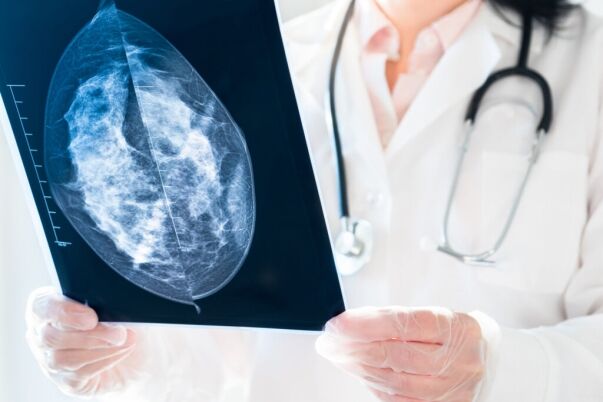
Learn about exciting new technologies that are revolutionizing breast cancer diagnosis
Key Takeaways
- While mammograms are still the gold standard for breast cancer screening, new technologies on the horizon hold promise.
- Artificial intelligence can provide insight beyond human capability.
- 3D mammograms and MRI offer more in-depth views of the breast.
- Liquid biopsy looks for traces of cancer DNA in the blood.
Mammograms are a common first step in breast cancer detection, and their use has contributed to a 43 percent decline in breast cancer deaths from 1990 to 2022. But they are not the only diagnostic tool doctors use, and there are new technologies on the horizon. BCRF is committed to supporting bold research into precision prevention and technological innovations like artificial intelligence (AI), 3D mammography, and liquid biopsies that show promise in reshaping breast cancer diagnosis and have the potential to drive lifesaving progress.
The role of artificial intelligence in breast cancer diagnosis
The role of AI in breast cancer diagnosis expands the concept of a second opinion beyond human capabilities: Machine-learning algorithms can process tremendous volumes of data to identify patterns undetectable by the naked eye. As such, they can augment the information from mammograms, ultrasounds, and other tests, providing greater detail that enables radiologists to better identify anomalies in breast cancer images. AI can also play a role in biopsy analysis by providing a tool to more fully detect molecular biomarkers in pathology samples. This information can lead to enhanced precision breast cancer care plans, as well as more targeted treatments.
AI models are already being used to evaluate breast cancer risk well beyond established risk factors. BCRF-supported researcher Dr. Constance Lehman is the founder of Clairity Breast, the first AI-driven breast cancer risk assessment tool to receive De Novo authorization from the U.S. Food and Drug Administration.
Guidelines recommend that women with no known family history of breast cancer or genetic mutations start receiving annual mammograms at age 40. Only 15 percent of women with breast cancer qualify for earlier testing, meaning 85 percent of women who are diagnosed with the disease have no known risk factors. To close this gap, Dr. Lehman advocates having a baseline mammogram at age 30. The Clairity Breast platform uses that initial image to calculate an AI-informed risk score. That score can determine who could benefit from earlier, personalized regular imaging. And it evolves: Every time a woman has a mammogram, each image builds on the last, continually updating the score to provide an actionable, real-time assessment that could affect her healthcare choices and daily life.
Machine learning can also guide treatment decisions. BCRF investigator Dr. Karen Taylor is validating an algorithm based on the expert human analysis of about 22,000 patient samples. Her AI system will assess these digitized images for new patterns, which could produce further insights for individual treatment options.
AI is also transforming our understanding of recurrence risk. The TAILORx study, led by BCRF investigator Dr. Joseph Sparano, uses an AI model to analyze the molecular and clinical characteristics of a breast cancer to provide better predictive information about cancer recurrence risk up to 15 years, including early and late recurrence. It is another way that AI can help in treatment decisions and even long-term care.
3D mammography: redefining early detection
Aided by AI or not, traditional 2D mammography has its limitations, notably for women with dense breasts, who have a 15 to 20 percent higher risk of developing breast cancer compared to the national average. 3D mammography, also known as digital breast tomosynthesis, has been shown to improve breast cancer diagnosis in some women with dense breasts and reduce the false positives that occur frequently in ultrasounds. Like 2D mammograms, 3D mammograms use X-rays, but instead of taking just a few pictures, digital breast tomosynthesis takes multiple images of the breast in an arc. Software layers those fragments into cross-sections, so radiologists can review digital “slices” of the breast.
However, there is not yet consensus on how these advanced breast cancer images should be integrated into breast cancer diagnosis protocols. BCRF researchers Dr. Wendie Berg and Dr. Christopher Comstock are both evaluating contrast-enhanced mammography (CEM), which combines mammography with an iodine dye that makes cancer easier to identify. CEM costs less than MRI screening and takes less time.
Dr. Berg’s study of cancer detection rates in women who are screened annually with 3D mammography and CEM has so far shown rates similar to MRI screening, with fewer false positives. Likewise, early results from Dr. Comstock’s trial of CEM, conducted by the American College of Radiology in collaboration with BCRF and GE Healthcare, indicate improved breast cancer diagnosis with CEM by 70 to 80 percent over mammograms alone in women with dense breasts.
A revolutionary noninvasive diagnostic advancement
Similar to how your body sheds skin cells and hair, tumors release bits of DNA that end up in the blood. Liquid biopsy is a blood test that can detect those fragments, called circulating tumor DNA (ctDNA). A simple blood draw to check for cancer has obvious appeal over a more invasive traditional biopsy, which may require surgery. A liquid biopsy can detect microscopic traces of cancer that are too small to see on imaging, and the results can be available faster than traditional biopsies. This could provide an opportunity for doctors to determine whether cancer has been fully eliminated after treatment, even if it’s too small to see on imaging. Another way to leverage ctDNA technology may also be to monitor disease progression throughout treatment so that treatment decisions can be made in real-time and more swiftly.
The challenge is that the amount of ctDNA in blood can be infinitesimally small, perhaps as little as 10 fragments among a few million white blood cells and a billion red blood cells in a milliliter of blood. Currently, this low abundance reduces the utility of liquid biopsy for diagnosis. But that is changing as BCRF researchers like Dr. Ben Park are devising ways to leverage technological advances to overcome these limitations. A large BCRF-supported study of triple-negative breast cancer presented at the BCRF 2025 symposium showed that ctDNA strongly predicts recurrence, which could mean that liquid biopsies could identify relapse far earlier than is possible now, perhaps even years in advance.
The impact of advanced imaging on breast cancer outcomes
Advanced imaging tools like PET scans and MRIs are key for evaluating breast cancer. PET scans use a radioactive tracer to show changes in the breast at the cellular level. They are often used along with an MRI, which is a more sensitive test involving radio waves that create images of structures within the breast. MRIs identify more breast cancers than mammograms but have more false positives too.
Although MRIs are less cost-effective than mammography, the underlying value of adding AI-driven analysis to MRI imaging may be to increase the accuracy of the interpretation. With improved accuracy in diagnosis, more efficient and effective treatment decisions can be made. MRI images are repositories of complex information and provide a rich source for AI-driven analytics. With AI’s ability to learn from image after image, it becomes better and better, potentially yielding large amounts of data related to features like tumor shape, borders, and texture.
How your donations drive progress
BCRF-supported investigators have touched every major advancement in breast cancer prevention, diagnosis, treatment, and survivorship in the past 30 years. The latest technological innovations surrounding AI diagnostics, 3D imaging, and liquid biopsies extend this long line of progress.Such impactful research doesn’t exist in isolation but across studies, institutions, and industries – relationships and collaborations fostered by BCRF.
Every hour of research brings us closer to a cure. Support the latest advancements in breast cancer care today.
Frequently asked questions about breast cancer diagnosis
1. How has technology changed breast cancer diagnosis?
Technology is transforming breast cancer diagnosis and care. AI-powered imaging and 3D mammography are making detection more accurate, reducing false positives, and enabling cancers to be found earlier—when treatment is most effective. At the same time, liquid biopsies are opening the door to less invasive, blood-based methods for monitoring cancer, offering patients safer and more convenient options for ongoing care.
2. What are AI tools for breast cancer?
AI tools analyze mammograms, MRIs, and ultrasounds to identify patterns associated with breast cancer. They help radiologists spot subtle abnormalities, reduce diagnostic errors, and in research and clinical decision-support settings, help estimate recurrence risk. By integrating imaging, patient data, and tumor characteristics, these tools support more personalized treatment planning.
3. What are the latest advancements in breast cancer treatment?
Recent progress in breast cancer treatments include targeted therapies, immunotherapy, and precision medicine. Targeted drugs act on specific molecular alterations, immunotherapy strengthens the immune system’s ability to fight cancer, and personalized treatments are guided by each patient’s tumor genetics and molecular profile. Many of these breakthroughs have been supported by research funded by the Breast Cancer Research Foundation (BCRF).
4. What is the new wonder drug for breast cancer?
While there is no single “wonder drug” for breast cancer, several newer treatments show promising results. ENHERTU® (trastuzumab deruxtecan) has been especially impactful for HER2-positive disease, while Verzenio® (abemaciclib) has demonstrated substantial benefits for hormone receptor–positive/HER2-negative breast cancer when used alongside endocrine therapy. These breakthroughs are changing the way breast cancer is treated and offering new hope to patients.
5. What new cancer drug has a 100 percent success rate?
No breast cancer drug works for every patient. Cancer is highly individualized, and treatment responses vary widely. Newer therapies, such as KISQALI® (ribociclib) and ENHERTU, demonstrate strong effectiveness for specific cancer subtypes; however, none guarantees universal success.
6. What is the new test instead of a mammogram?
Newer tests are enhancing—but not replacing—traditional mammography. 3D mammography delivers clearer, layered images, making it easier to detect cancer in dense breast tissue. Breast MRI and ultrasound can provide additional detail when used alongside mammograms. Meanwhile, liquid biopsies are emerging as a noninvasive option, offering the potential to detect cancer early through a simple blood draw. Together, these advancements represent exciting progress in breast cancer detection, fueled by ongoing BCRF supported research.
Selected references 
American Association for Cancer Research. “A Multimodal AI Model May Improve Recurrence Risk Stratification in Early Breast Cancer.” AACR, www.aacr.org/about-the-aacr/newsroom/news-releases/a-multimodal-ai-model-may-improve-recurrence-risk-stratification-in-early-breast-cancer/.
American Cancer Society. Cancer Prevention and Early Detection Facts and Figures 2024. American Cancer Society, 2024, www.cancer.org/content/dam/cancer-org/research/cancer-facts-and-statistics/cancer-prevention-and-early-detection-facts-and-figures/2024-cped-files/cped-2024-cff.pdf.
American Society of Clinical Oncology. “Breast Cancer Mortality Rates May Have Stopped Declining.” The ASCO Post, Mar. 2025, ascopost.com/news/march-2025/breast-cancer-mortality-rates-may-have-stopped-declining/.
Baptist Health. “PET Scan vs. MRI: What’s the Difference?” Baptist Health Blog, www.baptisthealth.com/blog/health-and-wellness/pet-scan-vs-mri-what-s-the-difference.
Breast Cancer Research Foundation. “5 Takeaways from BCRF’s Webinar on AI and Breast Cancer Risk.” BCRF Blog, www.bcrf.org/blog/5-takeaways-from-bcrfs-webinar-on-ai-and-breast-cancer-risk/.
“7 Key Takeaways from BCRF’s 2025 Symposium.” BCRF Blog, www.bcrf.org/blog/7-key-takeaways-from-bcrfs-2025-symposium/.
“AI and Breast Cancer.” BCRF Blog, www.bcrf.org/blog/ai-breast-cancer/.
“AI in Breast Cancer Detection and Screening.” BCRF Blog, www.bcrf.org/blog/ai-breast-cancer-detection-screening/.
“Breast Cancer in Young Women.” BCRF, www.bcrf.org/about-breast-cancer/breast-cancer-young-women/.
“Christopher E. Comstock, MD.” BCRF, www.bcrf.org/researchers/christopher-e-comstock/.
“Clairity Breast AI: Artificial Intelligence Mammogram Approved.” BCRF Blog, www.bcrf.org/blog/clairity-breast-ai-artificial-intelligence-mammogram-approved/.
“Dense Breast Tissue.” BCRF, www.bcrf.org/about-breast-cancer/dense-breast-tissue/.
“New Technology in Cancer Research.” BCRF Blog, www.bcrf.org/blog/new-technology-cancer-research/.
“Wendie Berg, MD, PhD.” BCRF, www.bcrf.org/researchers/wendie-berg/.
Food and Drug Administration. “MQSA National Statistics.” FDA, www.fda.gov/radiation-emitting-products/mammography-information-patients/mqsa-national-statistics.
MedlinePlus. “Mammography.” National Library of Medicine, medlineplus.gov/ency/patientinstructions/000837.htm.
Oxford University Press. “Artificial Intelligence in Breast Imaging.” Journal of Breast Imaging, vol. 7, no. 4, academic.oup.com/jbi/article/7/4/420/8058734.
Yale School of Medicine. “Advanced 3D Mammography Detects More Breast Cancers with Fewer False Positives.” Yale Medicine, medicine.yale.edu/news-article/advanced-3d-mammography-detects-more-breast-cancers-fewer-false-positives/.

