

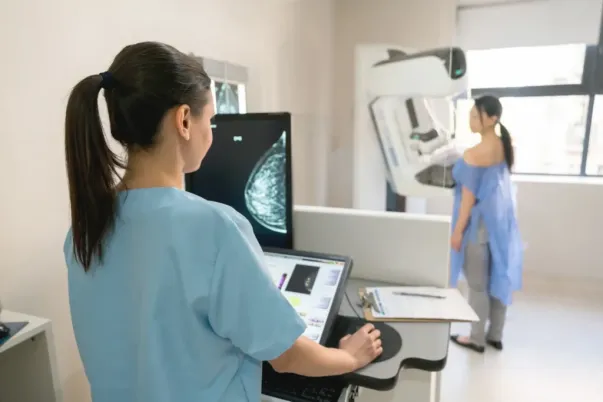
BCRF-funded research found that changes in AI-derived risk scores may reveal important clues about future breast cancer risk years before diagnosis
Key Takeaways
- BCRF-funded researchers found that AI-generated breast cancer risk scores from routine mammograms change over time and may reveal important clues about future breast cancer risk.
- Risk scores increased years before diagnosis in women who later developed breast cancer, while remaining stable in women who stayed cancer-free.
- Differences in risk trajectories were detectable as early as six years before a breast cancer diagnosis.
- Because most breast cancers occur in women without a strong family history or known genetic mutation, AI-based risk assessment could help identify women who might otherwise be missed by traditional risk models.
- AI risk scores are not a diagnosis, but they may help guide more personalized screening and prevention strategies.
For decades, mammograms have been an important tool used to detect breast cancer as early as possible. Thanks to the Breast Cancer Research Foundation (BCRF)-funded research, healthcare professionals can use artificial intelligence (AI) to help predict breast cancer risk over the next five years. But new BCRF-funded research suggests that changes in those AI-generated risk scores may offer clues about a woman’s long-term breast cancer risk years before the disease develops.
In a new study published in Radiology, BCRF investigator Dr. Connie Lehman, founder of Clairity Breast and professor of radiology at Harvard Medical School, and colleagues found that AI-detected signals can change over time, producing a dynamic risk score that evolves and offers insight into long-term risk. Differences in risk trajectories were detectable as early as six years before a breast cancer diagnosis.
“We observed clinically relevant differences in risk trajectories between women who did and did not develop cancer,” Dr. Lehman said. “The increase in scores among cancer patients was detectable as early as six years prior to diagnosis and became more pronounced over time.”
To better understand how breast cancer risk changes over time, Dr. Lehman and colleagues analyzed nearly 160,000 mammograms from more than 54,000 women.
Rather than examining a single mammogram, the researchers evaluated multiple years of screening images from each participant and used an AI model to generate a five-year breast cancer risk score based solely on the mammogram itself.
The findings were striking.
Among women who developed breast cancer, AI risk scores increased steadily over the six years preceding diagnosis, rising from a median score of 2.1 five to six years before diagnosis to 6.6 at the final screening exam before diagnosis. The increase became especially pronounced during the two years immediately preceding diagnosis.
In contrast, women who remained cancer-free had relatively stable scores throughout the study period, with median scores ranging from 1.8 to 2.2.
Together, these findings point toward a future where breast cancer risk assessment is more personalized, dynamic, and potentially more effective at identifying women who may benefit from enhanced screening or prevention strategies.
From BCRF-Funded Research to Clinical Practice
This research builds on earlier work that helped lead to the development of Clairity Breast, an FDA-authorized AI platform that estimates a woman’s five-year breast cancer risk from a screening mammogram.
Unlike traditional risk models that rely on factors such as family history, age, or breast density, Clairity analyzes the mammogram itself to identify patterns associated with future breast cancer risk.
“These findings demonstrate that we can take an image and identify signals, invisible to the human eye, that can predict future risk,” Dr. Lehman said. “Our findings demonstrate that image-based AI risk scores evolve over time and that changes in those scores may provide additional information about future breast cancer risk.”
Looking Beyond Traditional Risk Factors
Today, breast cancer risk assessment often relies on factors such as age, family history, inherited genetic mutations, and breast density. While these tools are valuable, they don’t tell the whole story.
In fact, approximately 85% to 90% of women diagnosed with breast cancer do not have a significant family history of the disease or a known inherited genetic mutation. As a result, many women who ultimately develop breast cancer would not be considered high risk using traditional approaches alone.
Reflecting the growing promise of these tools, the National Comprehensive Cancer Network recently incorporated AI-based mammographic risk assessment into its breast cancer screening guidelines to begin at age 35.
What Does an AI Risk Score Mean?
For patients, it’s important to understand what these scores do—and do not—tell us.
An elevated AI risk score does not mean a person has breast cancer, nor does it guarantee that they will develop the disease in the future.
Instead, the score estimates the likelihood of developing breast cancer within a specified period of time. This information may help clinicians identify women who could benefit from additional screening, closer monitoring, preventive medications, lifestyle interventions, or other risk-reduction approaches.
In other words, these tools are designed to assess risk—not diagnose cancer.
A New Era of Dynamic Risk Assessment
Traditionally, breast cancer risk has been estimated using a single assessment based on known risk factors. This study suggests that changes in risk over time may provide additional information about a woman’s likelihood of developing breast cancer.
“Having a dynamic risk score opens up a whole new domain of more effective diagnosis and preventive therapies for breast cancer, similar to how we screen for and treat patients with high cholesterol and hypertension,” Dr. Lehman said.
Just as physicians monitor blood pressure or cholesterol levels over time to guide preventive care, AI-generated risk scores could eventually help clinicians track changes in breast cancer risk and tailor screening recommendations accordingly.
What Comes Next?
AI-based breast cancer risk assessment is already beginning to move from research into clinical care, with image-based risk models now recognized in screening guidelines and available in select healthcare settings (Clairity Breast is currently available at Beth Israel Deaconess Medical Center in Massachusetts, at Invision Sally Jobe in Colorardo, and is on track for continued expansion).
While additional research is needed to determine how changing AI-derived risk scores should be incorporated into routine care, the findings point toward a future where mammograms may be used to do more than detect cancer. They may help doctors identify women at elevated risk much earlier, creating new opportunities for personalized screening, prevention, and intervention before cancer develops.

