
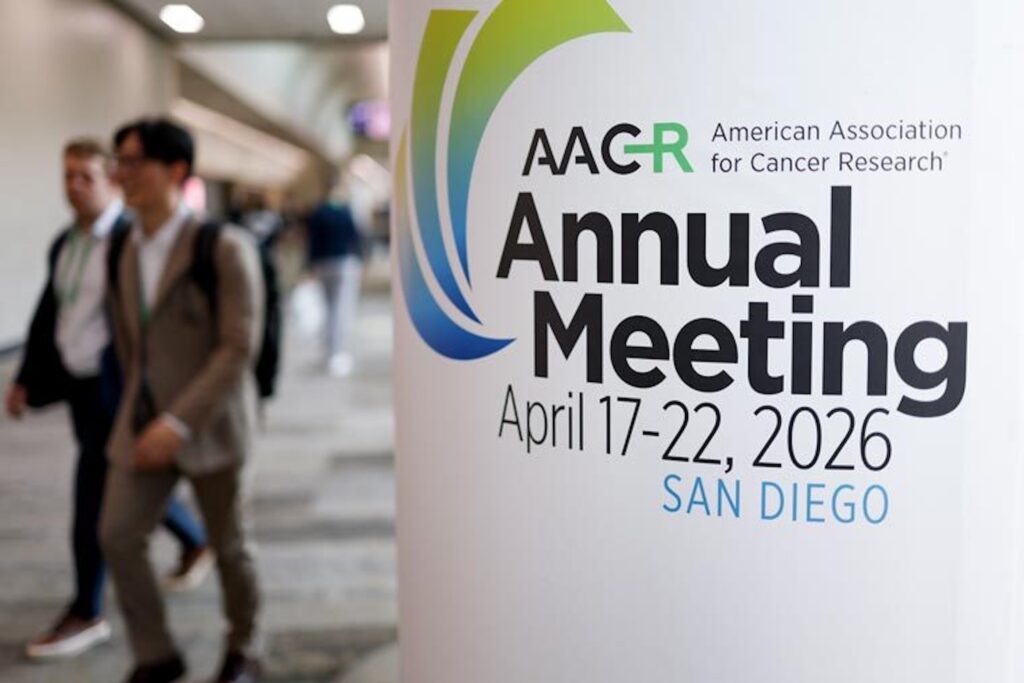
From addressing the rise of young onset breast cancer to the use of AI in pathology, these are the key findings presented at the American Association for Cancer Research 2026
Key takeaways
- The American Association for Cancer Research (AACR) hosted its annual meeting last month.
- Key takeaways included addressing why young-onset cancers are on the rise, new treatment modalities, and more.
- Here’s what you need to know about key findings presented at AACR 2026.
The American Association for Cancer Research (AACR), the world’s largest professional organization for cancer research, brought more than 20,000 scientists, doctors, and advocates together for its 119th annual meeting. Among the key themes of AACR 2026 was that meaningful progress in cancer care depends on integration of multi-disciplinary research that connects discoveries in foundational biology to the clinic. Researchers, including several funded by the Breast Cancer Research Foundation, shared discoveries across the continuum of cancer research, with the understanding that breakthroughs in one cancer type can help improve treatment and care for others.
Here’s what you need to know about the latest in breast cancer research from AACR.
Artificial Intelligence Is Reshaping Cancer Research and Care
Researchers are working to crack the cancer code by employing innovative and creative strategies starting in the lab with an eye towards moving them into clinical practice. As one of these strategies, artificial intelligence (AI) has not only entered the realm of cancer research, but it is also advancing it at record pace. Several presentations covered the newest in AI-driven progress, including in:
- Pathology—AI systems can now analyze tumor slides with remarkable precision, identifying subtle patterns that may predict prognosis or treatment response more accurately than traditional methods alone.
- Screening—Researchers, including BCRF investigator Dr. Adam Yala, are leveraging AI-driven image-based models to improve detection and risk prediction. As these models become more sophisticated, they may help reduce false positives, detect cancers earlier, and personalize screening recommendations.
- Drug development—Foundation models as described by BCRF investigator Dr. Regina Barzilay (large AI systems trained on large biological datasets) are now being used to analyze tumor-associated proteins to find regions where drugs can bind. By identifying these regions more precisely, designing drugs to fit them can be accelerated, dramatically shortening the timeline for developing new treatments.
- Accessibility—AI has the potential to democratize precision oncology by bringing sophisticated analytical capabilities to healthcare systems that may not otherwise have access to specialized expertise. If implemented thoughtfully, AI could help reduce disparities in cancer care globally.
Researchers described AI not as a replacement for scientists or clinicians, but as a “co-scientist”—an increasingly powerful partner capable of accelerating discovery and improving cancer care. They emphasized that these tools remain in relatively early stages and require careful benchmarking and validation. Still, the pace of advancement is extraordinary, and many believe AI could fundamentally change how therapies are discovered, developed, and much more.
Addressing the Rise of Young Onset Cancer
One of the most urgent topics discussed was the rise of young-onset cancers, including colorectal cancer and breast cancer in young women, and the need to better understand why they are appearing earlier in life.
- Hyuna Sung, PhD, of the American Cancer Society, had a novel perspective on how we define “young onset.” She addressed this growing concern, but emphasized an important point often lost in the discussion: absolute cancer risk before age 50 remains low. Rather than defining “young adults” by a fixed age, Dr. Sung highlighted the value of a birth cohort framework—tracking cancer risk by generation rather than age—to help distinguish true signals from background related to screening, to capture the influence of early-life exposures, and to reveal how cancer risk evolves across the lifespan.
- Through this lens, risk can shift across generations and cancer subtypes, including breast cancer. For instance, estrogen receptor (ER)-positive disease has increased in more recent birth cohorts while ER-negative disease has declined, suggesting subtype-specific risk factors may be moving in opposite directions—an observation that may be further explored. She underscored how birth cohort analyses can identify emerging generational risks, identify high-risk birth cohorts, generate hypotheses, and reveal prevention impact.
To be sure, cancers are increasingly understood as the product of multiple interacting forces, including genetic mutations, environmental exposures, aging biology, the microbiome, stress, and social determinants of health.
Biology Can Inform Prevention Strategies
Several presentations explored how underlying biology can inform prevention efforts, including a key presentation by BCRF investigator Dr. Pepper Schedin.
Dr. Schedin walked us through how mammary biology, particularly during pregnancy, lactation, and weaning, plays a role in postpartum breast cancer (PPBC), the incidence of breast cancer between five and 10 years after giving birth.
- She explained that after breastfeeding ends, the breast naturally goes through changes that can create inflammation and even help tumors shed their cells. The liver also undergoes similar changes and is the site of many PPBC metastases.
- The Schedin team is focused on better understanding these changes, specifically tissue remodeling processes in PPBC, to identify opportunities for prevention and surveillance.
New Treatment Modalities Are Becoming Available
This year’s presentations showcased a wave of innovative therapies designed to move beyond traditional approaches and target cancer in increasingly sophisticated ways.
- Scientists are going beyond the original versions of antibody-drug conjugates (ADCs), developing newer ones that can better target and kill cancer cells.
- Researchers are also creating treatments that don’t just block harmful proteins but destroy them. One type, protein degraders called PROTACs, link target proteins to enzymes that drive their destruction. On the heels of AACR, the FDA approved the first PROTAC (vepdegestrant) for treating breast cancer.
- Engineered immune cell therapies, including CAR T-cell therapies, are continuing to improve and researchers are using AI to help make them more effective against solid tumors.
- Cancer vaccines are on the horizon, including more personalized ones that promote greater immune cell responses, mRNA vaccines to boost immunotherapies by activating patients’ immune systems, and even vaccines to improve specific forms of immunotherapies.
- Finally, vaccines for prevention and intervention before invasive cancer develops, particularly in high-risk cancers such as triple-negative breast cancer (TNBC), are emerging.
Despite the tremendous progress in designing new therapies, major questions remain regarding the best timing, how to administer treatments, and whether universal or personalized vaccines will be the most effective. These questions are the focus of cancer research going forward.
Understanding the Evolving Ecosystem of Cancer
Perhaps the most important overarching theme was the growing recognition that cancer behaves as a dynamic, evolving ecosystem rather than a fixed disease. Researchers increasingly believe that overcoming treatment resistance will require understanding not only tumor genetics, but also the surrounding environment, immune interactions, and physical forces shaping tumor evolution.
Researchers are working to better understand why minimal residual disease (MRD), where a few residual cancer cells may remain after treatment and potentially lead to relapse, happens. Scientists described how left-over cancer cells interact with the body to become more resistant over time. Tumor plasticity (the ability of cancer cells to shift identities and adapt under therapeutic pressure) seems to play a critical role in resistance. This work is helping identify entirely new ways to prevent recurrence
Minimal residual disease (MRD) can be detected through liquid biopsies that measure circulating tumor DNA (ctDNA), often before relapse is visible on imaging. Dr. Carmen Li of University of Pennsylvania presented her findings in TNBC. She reported that patients who remain ctDNA-positive after treatment face a significantly higher risk of recurrence, while ctDNA-negative patients tend to have low recurrence rates, making ctDNA a promising indicator of how aggressive the disease may be. Researchers hope to eventually use MRD/ctDNA testing to guide clinical decision-making, enabling earlier intervention, more personalized treatment, and better assessment of a patient’s level of risk. Although more sensitive and consistent tests are still needed before this can be widely used in patient care, MRD is already changing how clinical trials are designed by helping researchers identify higher-risk patients and test treatments more efficiently.
In a session focused on resistance to antibody-drug conjugates (ADCs), BCRF researcher Dr. Sarat Chandarlapaty explored how tumors can evolve to resist HER2-targeted ADCs, including trastuzumab deruxtecan (T-DXd). He described emerging evidence that some cancers develop resistance through changes in the drug’s target itself—including HER2 mutations or reduced HER2 expression—that can limit the drug’s ability to enter tumor cells and deliver its cancer-killing payload. Beyond changes in HER2 itself, Dr. Chandarlapaty highlighted how neighboring proteins that interact with HER2 may also influence drug sensitivity and could provide new treatment avenues. Dr. Chandarlapaty underscored how understanding resistance at the level of both the target and its surrounding cellular environment may help guide strategies to restore drug activity and inform future therapies.
Looking Ahead
This year’s AACR meeting presentations painted a clear picture of where oncology is headed: toward smarter detection, more personalized therapies, deeper biological understanding, and a renewed focus on why cancers resist treatment in the first place. Across disciplines—from AI to immunotherapy to prevention science—researchers emphasized one central theme: cancer is not static. It evolves over time, interacts dynamically with its environment, and demands equally adaptive approaches to care.
Many of the discoveries presented are already moving toward clinical trials and may have near-term impacts on both patient care and public health. The challenge now is ensuring these advances translate into equitable, effective, and durable improvements for patients everywhere.
BCRF Investigators Honored
BCRF proudly acknowledges two of our investigators who received awards at AACR:
David L. Rimm, MD, PhD received the AACR James S. Ewing-Thelma B. Dunn Award for Outstanding Achievement in Pathology in Cancer Research.
Charles W. M. Roberts, MD, PhD received the AACR-Daniel D. Von Hoff Award for Oustanding Contributions to Education and Training in Cancer Research.