
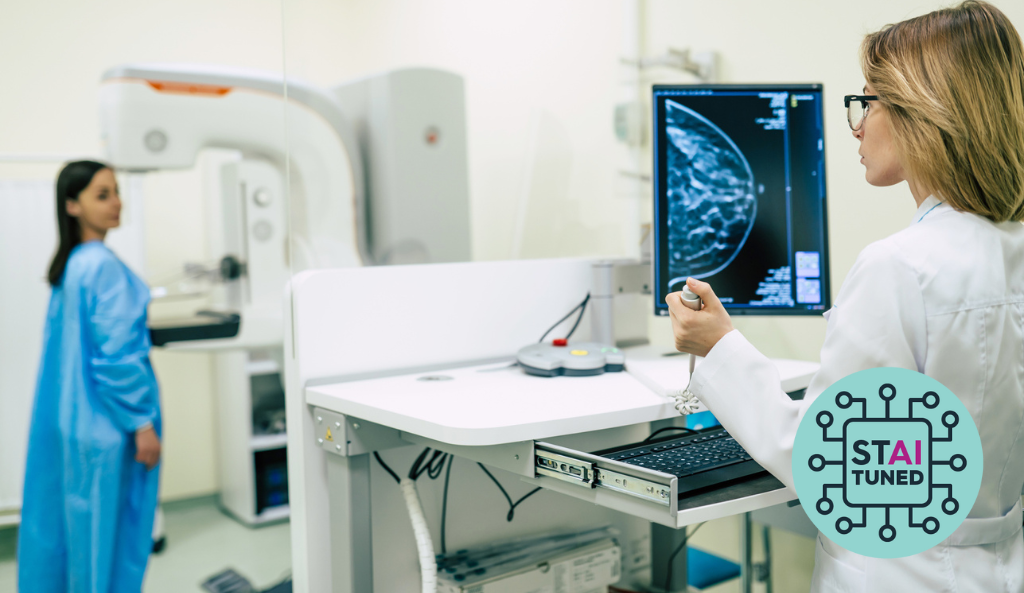
How researchers are working to integrate these technologies into breast cancer screening and diagnostics—and what challenges remain for wider use
Artificial intelligence may seem like a buzzword, but it’s quickly emerging as a key player in the breast cancer prevention landscape. Specifically, AI breast cancer detection tools are helping to identify cancer earlier and more accurately—which may improve outcomes and even save lives.
Deaths from breast cancer have fallen 43 percent over the last three decades thanks to advancements in screening and treatment. Regular screening—most commonly through mammography—is currently the primary way to detect breast cancer. Now, AI is helping improve how experts interpret findings. When caught early, breast cancer is more likely to be smaller and confined to the area, often reducing the need for aggressive treatment as well as improving outcomes.
Mammography has long been the gold standard for detecting breast cancer. But new advancements in AI technology applied to standard imaging makes this tool even more effective. While mammograms are highly reliable, some patients may require additional imaging, such as ultrasound or MRI—particularly those with dense breast tissue or elevated risk factors like genetic mutations or family history. In some cases, doctors may also order follow-up testing to clarify initial findings.
Mammograms and other tools continue to save lives, which is why improving screening technology and pathology remains a major focus of research—areas where AI is showing significant promise.
Here in part two of BCRF’s “StAI Tuned” series, we discuss how AI and machine learning (ML) are being integrated into screening and diagnostic procedures to find breast cancer in its earliest stages.
Read part one on AI’s potential in breast cancer research, part three on precision medicine and predictive analytics, and part four on AI’s role in drug development and clinical trials.
Common ways to detect breast cancer
If a lump can be felt, breast cancer can be detected with a self-exam or an exam by a doctor. But typically, routine screening through mammography helps identify abnormalities before symptoms appear or a lump is even felt. Additional imaging via ultrasound or MRI may provide a clearer view, particularly for people with dense breast tissue or those at a high-risk of breast cancer. If a screening reveals an abnormality, doctors typically perform a biopsy to determine whether cancer is present.
As screening technologies continue to evolve, new tools are helping improve how breast cancer is detected. Among the most promising advancements is the use of AI to enhance the accuracy and efficiency of these methods.
Can AI detect breast cancer?
While highly skilled radiologists interpret breast images, AI can now help. Radiologists are experts in both selecting any additional imaging technique(s) to use with patients and comprehensively assessing each patient’s anatomy, any abnormalities or pathologies detected, and their significance. When a person gets a mammogram or other type of screening, their radiologist describes and details each finding, including its location, size, shape, density, or other relevant features. AI comes into play beyond making radiologists’ workflow more efficient. AI-driven tools can provide quantitative analyses that are not subject to human bias, making data-driven calls for hard-to-read mammograms that could be interpreted differently. AI-powered software can also automate the interpretation of mammograms, ultrasounds, and MRI scans to get patients their results faster.
Even more, AI techniques can help radiologists identify breast cancer that would have otherwise been undetectable in its early stages. Techniques like image enhancement and de-noising—decreasing the background shadows—can improve the quality of breast images and allow radiologists to view anatomical structures more clearly. As such, AI-powered tools can detect subtle abnormalities, decipher ambiguous features, and identify patterns and characteristics that may not immediately jump out to the human eye. AI tools can also estimate tumor size and shape. Together, these advantages position AI as a powerful partner to doctors in making screening more precise and reducing both false positive and negative results.
AI-powered breast imaging may also improve breast cancer care in low-resourced or rural areas, where women may lack easy access to specialists and experts. With remote interpretation capabilities, AI systems facilitate timely diagnosis and treatment regardless of where patients live. Plus, improvements in interpretation of mammograms may reduce follow-up visits, biopsies, and more costly screening tests like MRI.
What is an AI-assisted mammogram?
An AI-assisted mammogram uses artificial intelligence to assist in analyzing mammography images. These sophisticated systems evaluate scans to detect subtle abnormalities, measure tumor characteristics, and flag areas that may require closer review by a radiologist.
By enhancing how mammograms are interpreted, AI can help reduce false positives and false negatives, streamline workflows, and provide faster results. As a result, AI mammograms are becoming an increasingly valuable tool in improving breast cancer detection and patient care.
BCRF researchers advancing AI-based screening
BCRF investigators Drs. Constance Lehman, Regina Barzilay, and Adam Yala developed and tested a mammography-based deep learning model called MIRAI. To do this, they utilized a large set of diverse patient data, analyzed multiple mammogram images over time, and integrated risk factor information into the tool’s analysis. The team demonstrated that MIRAI could yield individualized, equitable, and cost-effective improvements in breast cancer risk prediction compared to traditional risk models. Importantly, MIRAI provides consistent results across mammography sites and machines.
Drs. Yala and Dr. Barzilay are now conducting a BCRF-supported prospective study testing MIRAI’s ability to predict which patients are high-risk and following their progress through MRI screening. This study will validate results demonstrating that MIRAI can identify patients with a high-risk of developing breast cancer in the next five years. Ultimately, the results of the study could help redefine breast cancer screening guidelines and design novel protocols for managing high-risk patients.
With BCRF support, Dr. Lehman and her team created an AI-driven breast cancer risk prediction platform, Clairity Breast, that can predict a woman’s risk of developing breast cancer over the next five years directly from a routine screening mammogram. Clairity Breast is the first-of-its-kind, U.S. Food & Drug Administration (FDA)-authorized platform for risk prediction, surpassing traditional breast cancer risk models that rely on factors such as age, reproductive and family history, and genetic mutations. Clairity Breast represents a major advancement in breast cancer risk prediction and prevention, helping to identify high-risk women who may be missed by traditional models, improving early detection and personalized care for women nationwide including younger women (under 50) for which screening is not routinely recommended. Another risk stratification tool, ArteraAI Breast, was cleared by the FDA in May 2026.
AI and pathology
If screening reveals an abnormality, a breast tissue biopsy is usually the next step. During a biopsy, a pathologist studies a sample of tissue under a microscope for cancer cells, their growth patterns, and characteristics in the cells and tissue that indicate the breast cancer subtype and grade. Timely and accurate diagnosis is critical to get a patient into treatment, and integrating AI into digital pathology is proving to be a revolutionary tool to improve imaging sensitivity, speed, and specificity.
AI can identify subtle patterns and features in digitized pathology images that human eyes may overlook. For example, AI-powered algorithms can detect malignant cells, assess a tumor’s features, and predict tumor aggressiveness accurately and with high sensitivity.
AI can analyze vast amounts of medical data with speed and precision, which is invaluable to pathologists. These tools can analyze whole slide images of breast lesions and classify them into distinct categories, including invasive carcinomas, microinvasive carcinomas, ductal carcinomas in situ (DCIS), and benign breast lesions. Microinvasive carcinomas may be found alongside DCIS and identifying them can be very difficult and time-consuming.
AI and clinical decision-making
Breast MRI can reveal characteristics of a tumor and its environment that are helpful for diagnosing high-risk patients. MRI images contain complex information, making them an abundant source from which AI can extract data. AI is especially helpful here as it can learn descriptive features like tumor shape, borders, and texture, providing another set of “eyes.” In fact, it has improved MRI detection and characterization of breast cancer and will improve the use of imaging biomarkers in clinical decision-making.
Biopsy samples can also reveal molecular biomarkers of breast cancer. Key biomarkers in and on breast cancer cells—including estrogen receptors (ER), progesterone receptors (PR), human epidermal growth factor 2 (HER2), and Ki-67—indicate the subtype of breast cancer and how rapidly it is growing. These details inform an individual’s treatment, while AI tools are enabling more accurate detection of these biomarkers, including low and ultra-low levels of HER2, so patients can get the right diagnosis and treatment.
BCRF investigator Dr. Karen Taylor is digitizing about 22,000 diagnostic pathology slides from breast cancer patients and creating infrastructure to validate AI algorithms using the data. The AI systems will analyze these images to look for new patterns in both the cancer cells and the surrounding tissue cells to gain insight into how the cancer will respond to different treatments. Her work validating these tests will aid pathologists in routine reporting and allow clinicians to make better individualized treatment decisions.
Meanwhile, BCRF investigator Dr. Jakob Kather and his team are creating and testing a comprehensive benchmark for evaluating AI performance specifically in breast oncology. They hope to leverage the potential benefits of AI—such as personalized patient education and faster creation of medical guidelines—while minimizing risks. Their work will help to optimize AI’s use and provide the groundwork for responsible integration of AI into breast cancer care to ultimately benefit patients.
Are there any drawbacks to using AI breast cancer detection tools?
By harnessing the power of AI-driven analytics and automation, healthcare providers can deliver more precise, efficient, and tailored breast cancer care. AI is poised to revolutionize screening, offering unprecedented opportunities to make it faster and more accurate—ultimately saving lives and improving outcomes in the process. But there are some drawbacks to consider.
Despite its transformative potential, there are challenges for AI on the road to widespread adoption in imaging. Using these tools requires extensive research to validate their accuracy and ensure application to widespread populations. Data standardization, regulatory compliance, and ethical considerations all pose significant barriers to scalability and widespread implementation in the real world. But if clinicians can understand and feel confident in AI tools, they can provide their patients with a rationale behind the recommendations and gain their trust, creating a powerful and valuable synergy in imaging.
This is why AI-related research is essential in breast cancer. BCRF investigators and others are on the cutting edge of this field, doing the early work to make AI’s transformative potential a reality for patients with breast cancer in the future.
The bottom line
AI is already improving breast cancer detection through enhanced mammogram analyses that help with imaging interpretation. These tools also support clinical decision-making, helping to move breast cancer screening toward a more precise, risk-based, and personalized approach.
But AI does not replace radiologists and pathologists who remain critical to accurate diagnoses and treatment planning. Instead, AI serves as an additional layer of insight and support.
Ongoing research is expanding AI’s use in both clinical and real-world settings, from improving risk prediction to making high-quality screening in underserved areas more accessible. As these technologies continue to evolve, they have the potential to make substantial impacts across the continuum of breast cancer care.
Support the research driving these advancements. By funding innovation in AI and breast cancer detection, you can help accelerate earlier diagnoses, improve outcomes, and save lives.
Frequently Asked Questions About AI Breast Cancer Detection
Are AI mammograms more accurate than traditional mammograms?
AI mammograms can improve accuracy by helping radiologists detect subtle abnormalities that may be missed by the human eye. Studies have shown AI can reduce false positives and false negatives, but it is used as a support tool—not a replacement—for clinical expertise.
How does AI help detect breast cancer earlier?
AI analyzes large volumes of imaging data to identify patterns and early signs of cancer that may not be immediately visible. By enhancing image quality and highlighting areas of concern, AI can support earlier detection and more timely diagnosis.
Can AI replace doctors in breast cancer screening?
In short, no. AI is designed to assist radiologists and pathologists, not replace them. Clinicians use AI as an additional tool to improve efficiency and accuracy while still making the final diagnosis and treatment decisions.
Selected references 
Ahn, J. S., Shin, S., Yang, S. A., Park, E. K., Kim, K. H., Cho, S. I., … & Kim, S. (2023). Artificial Intelligence in Breast Cancer Diagnosis and Personalized Medicine. Journal of Breast Cancer, 26(5), 405.
Demircioglu, A., Grueneisen, J., Ingenwerth, M., Hoffmann, O., Pinker-Domenig, K., Morris, E., … & Umutlu, L. (2020). A rapid volume of interest-based approach of radiomics analysis of breast MRI for tumor decoding and phenotyping of breast cancer. PloS one, 15(6), e0234871.
Galati, F., Rizzo, V., Trimboli, R. M., Kripa, E., Maroncelli, R., & Pediconi, F. (2022). MRI as a biomarker for breast cancer diagnosis and prognosis. BJR| Open, 4(1), 20220002.
Kim, I., Kang, K., Song, Y., & Kim, T. J. (2022). Application of artificial intelligence in pathology: trends and challenges. Diagnostics, 12(11), 2794.
Ng, A. Y., Oberije, C. J., Ambrózay, É., Szabó, E., Serfőző, O., Karpati, E., … & Kecskemethy, P. D. (2023). Prospective implementation of AI-assisted screen reading to improve early detection of breast cancer. Nature Medicine, 29(12), 3044-3049.
What Do Doctors Look for in Biopsy and Cytology Samples? (2023, August 1). Www.cancer.org. https://www.cancer.org/cancer/diagnosis-staging/tests/biopsy-and-cytology-tests/testing-biopsy-and-cytology-samples-for-cancer/what-doctors-look-for.html
Yala, A., Lehman, C., Schuster, T., Portnoi, T., & Barzilay, R. (2019). A deep learning mammography-based model for improved breast cancer risk prediction. Radiology, 292(1), 60-66.
Zheng, D., He, X., & Jing, J. (2023). Overview of artificial intelligence in breast cancer medical imaging. Journal of Clinical Medicine, 12(2), 419